Showing posts with label Rieter Latest Textile machines. Show all posts

Rieter - Drawframes RSB-D 40 and SB-D 40

clip_image002

clip_image004
clip_image006

A new dimension in drawframe technology
With the new RSB-D 40 autoleveler drawframe and the SB-D 40 drawframe Rieter has again achieved a quantum leap in draw-frame technology. The drawframe is the fi nal stage in the spin­ning process in which quality can be signifi cantly improved. Fluctuations in mass that are not eliminated on the drawframe reappear undiminished in the yarn. This is where the new Rieter drawframes reveal their decisive advantages – and
at delivery speeds of up to 1 100 m/min.
SUPERIOR YARN REGULARITY (USTER CV%)
· Further improved scanning precision and control dynamics
· Self-adjusting autoleveling function AUTOset
· Precise fi ber guidance in the drafting system
· Gentle web condensing with new web nozzle
SUPERIOR LONG-TERM COUNT MAINTENANCE (A%)
· Precise autoleveling, even with fl uctuating infeed quality
· Accurate autoleveling operation from start to fi nish
· Sliver coiling without false draft thanks to patented tube geometry
ENHANCED YARN CLEANLINESS
· Novel suction system with periodically lifting cleaning lips on the top rollers
· Uniform cleaning effi ciency due to automatic fi lter cleaning
· Neat coiling of manmade fi ber slivers and their blends using the CLEANcoil coiler
CONSISTENT QUALITY
· Stable, climate-resistant sensor technology
· Consistently short scanning length at all speeds
· Independent autoleveling system due to the single-head principle
· Rapid load relief on the top rollers in the event of lap formation
· Load relief on the top rollers in the event of machine stoppages
· Rieter Quality Monitor (RQM) online quality monitoring system
These advantages are based on wide-ranging experience with more than 24 000 Rieter drawframes that have been success­fully installed in 100 countries.
clip_image008
High spinning effi ciency at low capital cost
The RSB-D 40 and SB-D 40 signifi cantly raise quality standards in spinning mills at minimal capital cost. You achieve rapid payback of invested capital as a result of the high quality and signifi cantly improved running properties in subsequent processes.
HIGH PRODUCTIVITY
· Delivery speeds of up to 1 100 m/min in mill operations
· Delivery speed at least 10% higher than the previous model, with equal – in most cases even better – yarn quality
· High effi ciency due to faultless running, large can formats and short downtimes
· Up to 10 tonnes of sliver per day and drawframe
(sliver weight 7 ktex)
LOW OPERATOR EFFORT
· Superior accessibility through wide-opening hoods
· Perfect running behavior of the Rieter 4-over-3 drafting system
· Fast lap removal through rapid load relief on the top rollers
· Pneumatic sliver threading aid
· Easy operation with illustrated graphic display
· Automatic can changer with empty can feed for up to 8 cans
· Reduction in can transports due to large can formats up to 1 000 mm in diameter on the SB-D 40
LOW CLEANING EFFORT
· Novel cleaning lips keep top rollers clean
· Sliver path with suction system
· Automatic fi lter cleaning
· Long cleaning intervals when processing manmade fi bers
due to the honeycomb structure of the CLEANcoil coiler
LOW MAINTENANCE EFFORT
· Readily accessible central lubrication system
· Maintenance-free AC drive technology
· Low laboratory eff ort due to online quality monitoring
by the Rieter Quality Monitor (RQM)
· AUTOhelp integrated spectrogram diagnosis for rapid trouble-shooting
· SLIVERprofessional expert system on CD for setting recommendations and fault analysis
· Operating instructions and spare parts catalog on CD with video fi lms for better understanding
RAPID BATCH CHANGE
· Central setting of drafting distance without gauges
· AUTOset self-adjusting autoleveling
· Batch data management by MEMOset
LOW ENERGY CONSUMPTION
· Belt drives instead of complex gear arrangements
· Small number of motors and inverters compared to other drive concepts
· Lower masses and fewer drive elements reduce energy con­sumption by up to 10% compared to the predecessor model
COST SAVINGS IN DOWNSTREAM PROCESSING
· Small number of roving or fi ber ends down on the roving frame and fi nal spinning machine due to excellent sliver regularity
· Fewer clearer cuts on the winder or rotor spinning machine as a result of fewer yarn defects
· Good running properties in weaving operations due to low variation in yarn tenacity
· No quality outliers
Rapid response to market requirements
Flexibility in raw material selection and machine utilization is an important prerequisite for a successful spinning mill. You can respond rapidly to your customers‘ needs with the RSB-D 40 and SB-D 40.
HIGH FLEXIBILITY
· 70% of all applications with only one pair of scanning discs
· CLEANcoil – the coiler for all materials
· Integrated, non-mechanical sliver separation function for processing manmade fi bers
· Short-staple cotton can also be processed very well
· Batch data management by MEMOset
· Uniform operating philosophy on all Rieter machine displays for fl exible personnel assignment
· Variable drawframe layouts for optimum utilization of space available in the spinning mill
clip_image010
Advantages of the concept
RIETER – THE TRENDSETTER
Rieter was the fi rst manufacturer to introduce the concept of single-head drawframes some 25 years ago. This concept off ers quality, flexibility and operating advantages and has since con­tinued its victorious progress even in traditional double-head drawframe markets.


SUPERIOR QUALITY DUE TO INDEPENDENT AUTOLEVELING SYSTEM
The RSB-D 40 single-head autoleveler drawframe stands out for its high autoleveling and thus high sliver quality. This is also guaranteed by the independent operation of the autoleveling system. By contrast, a double-head autoleveler drawframe has the disadvantage – due to its design – that the drives of both autoleveling systems are connected via a common drawframe system delivery roller. The two autoleveling systems therefore infl uence each other and this results in inferior sliver quality.
A crucial factor in sliver quality is the accurate coordination of mechanical systems, drive, electronics and software. An experienced and well-coordinated development team resolved this decisive issue at Rieter. Double-head drawframes with autoleveling components from diff erent manufacturers do not produce even remotely comparable autoleveling results.
The signifi cantly better sliver regularity and coiling free of sliver breaks on the RSB-D 40 result in higher productivity on roving frames, spinning machines and winders as well as higher roving and yarn quality.
clip_image012
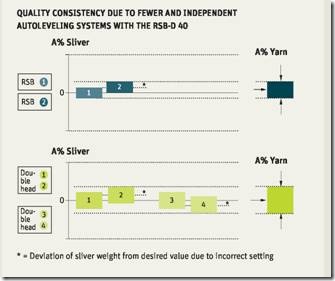
CONSISTENT QUALITY DUE TO FEWER AUTOLEVELING SYSTEMS Especially when several autoleveler drawframes are producing sliver for one yarn blend, accurate adjustment of the required sliver count on each individual drawframe is of highest impor­tance. Any incorrect setting of the required sliver weight, caused for example by errors in determining the weight in the laboratory, directly increases variances in yarn count through­out the blend. In mill operations this is frequently a reason for fl uctuations in yarn count.
Due to the high productivity of the RSB-D 40, the number of autoleveling adjustments is much smaller than on double-head drawframes running slowly and with lower effi ciency. Conse­quently, the risk of personnel-induced fluctuations in sliver count and thus yarn count is reduced with the RSB-D 40.
clip_image014
clip_image016
PRODUCTIVITY DUE TO HIGH DELIVERY SPEED AND HIGH EFFICIENCY
The productivity of the RSB-D 40 single-head drawframe com­pared to a double-head drawframe is incorrectly rated when the calculation is simply based on speeds quoted in sales lit­erature and the number of heads. In the case of the RSB-D 40, delivery speeds of 850 m/min are already standard in mill op­erations when processing carded cotton in ring spinning ap­plications. In rotor spinning applications even higher delivery speeds are already reality.
In addition to the signifi cantly higher delivery speeds of the RSB-D 40 in mill operations, production effi ciency is 10% to 20% higher than that of double-head autoleveler drawframes. At each sliver break in a feed can, can change at the infeed or delivery end, machine malfunction or maintenance operation, only one drafting system head is stopped on the RSB-D 40 – instead of two heads in the case of the double-head drawframe. This advantage increases with rising delivery speed. In addi­tion, the empty can magazine with up to 8 reserve cans, the ro­bust rotary can changer, trouble-free running and long cleaning intervals in the drafting system zone result in high effi ciency. Productivity is therefore also more independent of operators‘ infl uence.


SIMPLICITY DUE TO VERY GOOD ACCESSIBILITY
Accessibility is considerably better on the Rieter single-head drawframe than on any double-head drawframe, i.e. operating, adjusting and maintenance work can be performed more easily and therefore faster. This simplicity also motivates personnel to carry out optimization and maintenance operations willingly – quality and machine availability are assured.
FEWER TRANSPORT MOVEMENTS AND SLIVER PIECINGS DUE TO LARGE CAN FORMATS
The use of large feed cans with a diameter of 1 000 mm in a short, 2-row feed creel only makes sense on single-head drawframes in terms of the accessibility of the slivers and thus productive working methods.
The SB-D 40 (without autoleveling) enables 1 000 mm diame­ter delivery cans to be fi lled. Double-head drawframes of Asian design can only fi ll cans up to 400, 500 or 600 mm in diameter. This amounts to as many as 200 000 fewer can transport move­ments and sliver piecings a year with the Rieter drawframe and gives corresponding benefi ts in terms of operator eff ort and quality. For example, the number of cuts on the winder is re­duced by using larger can formats.
clip_image018
clip_image020
New RSB concept – even more precise, faster and more fl exible
THE RSB AUTOLEVELING PRINCIPLE
Fluctuations in sliver weight of up to ± 25% can be balanced by means of digital, high-precision RSB autoleveling. Fluctua­tions in the mass of the feed slivers are detected by „tongue­and-groove“ scanning discs. In this case the signals are col­lected at short, constant intervals, thus ensuring very high precision, even at maximum speed. The autoleveling processor uses the measured signals to compute a required speed for the highly dynamic AC servo drive. This value is transmitted to the drive exactly when the length of sliver measured reaches the drafting point in the main drafting zone. The result is a sliver with outstanding short, medium and long-term regularity.
PERFECT AUTOLEVELING STARTS WITH SCANNING ACCURACY Perfect autoleveling starts with the accuracy of feed sliver scanning. Errors made here can be corrected neither by a con­trol algorithm nor by higher drive dynamics. Compared to oth­er tongue-and-groove scanning systems, RSB scanning stands out for its very high precision. The vibration-damping structure of the scanning unit, the use of a belt drive instead of sluggish bevel gears and the use of absolutely temperature-stable sen­sors are only a few of the features on which the legendary RSB precision is based.
The RSB scanning system‘s pair of rotating „tongue-and­groove“ scanning discs measure the feed slivers without fric­tion. There are therefore no deposits – in contrast to a station­ary measuring lever – and the sensor system provides precise readings over a long period without the need for maintenance.
clip_image022
The RSB sensor system applies higher scanning forces and can therefore also accurately scan fi ber slivers of diff ering bulk. This is especially useful when feed cans are in intermediate storage for diff ering periods, since fi ber sliver bulk then diff ers especially from can to can. Only RSB scanning guarantees cor­rect scanning readings and thus the highest possible sliver count consistency, independently of the infl uence of operating personnel or material fl ow.
QUALITY DUE TO FURTHER IMPROVEMENTS IN SCANNING New and geometrically further optimized „tongue-and-groove“ scanning discs are used in the RSB-D 40. Measured-value res­olution and thus the accuracy of mass readings has therefore
been signifi cantly improved. Scanning disc loading with a new­ly developed, high-precision spring instead of compressed air ensures extremely robust autoleveling. Scanning force is con­stant, i.e. no adjustment to the raw material specifi cation is necessary. Some 70% of all applications can be covered with one pair of scanning discs.
DIGITAL AUTOLEVELING SYSTEM WITH HIGHLY DYNAMIC DRIVE
Processing and implementing the precise scanning signals
right through to the drafting system calls for special know-how. The autoleveling processor processes the signals on the basis of a sophisticated computing algorithm and transmits them to the highly dynamic, maintenance-free AC servomotor. A plan­etary gear superimposes the variable speed of the servo drive on the constant basic speed of the main motor. The servomotor therefore only has to produce the output necessary for autolev­eling and can thus be considerably smaller and therefore more dynamic than in concepts featuring individual drive motors. Piecings in combed slivers and coilers can also be leveled out reliably in this way.
FURTHER IMPROVEMENT IN AUTOLEVELING QUALITY ON THE RSB-D 40
The new drive concept ensures that the even more precise scanning readings are also transmitted right through to the drafting system, resulting in better sliver quality. The smaller mass of the dynamically powered drive elements compared to the previous model contributes to this. The drive concept with two fewer belts and the use of low-wear, ribbed V-belts im­prove power transmission accuracy. Supported by the high dy­namics, this concept ensures that even the shortest sliver defects are reliably leveled out, even at delivery speeds of
1 100 m/min. With the new model, delivery speeds can be in­creased by at least 10% for all materials, in most cases also with signifi cantly improved or equal yarn quality.
clip_image024
AUTOset self-adjusting autoleveling
AUTOMATIC ADJUSTMENT OF THE LEVELING ACTION POINT The leveling action point is the most important setting value in autoleveling. It specifi es the point at which a defect detected between the scanning discs is leveled out in the main drafting zone of the drafting system. Defi ning the leveling action point is a complicated process and calls for know-how on the part of operating personnel. An incorrectly set leveling action point will even make sliver quality worse than in the process with­out autoleveling. To date, several sliver samples had to be produced with diff erent settings, taken to the laboratory and examined on the regularity tester until the optimum leveling action point was found. AUTOset makes this complicated proc­ess a thing of the past.
At the push of a button, AUTOset automatically runs through all leveling action points in approx. 1 minute. At the same time the Rieter Quality Monitor records the resulting quality values of the sliver produced. An algorithm (patent pending) automat­ically calculates the optimum leveling action point. The pro­posed value is accepted by the push of a button – and that‘s it! This saves valuable time and ensures correct settings and thus superior sliver quality, even with inexperienced personnel.
MEMOSET ARTICLE MANAGEMENT
The RSB-D 40 takes a further step toward simplifi ed operation with MEMOset article management. MEMOset enables operat­ing personnel to use preset parameters based on a sound foun­dation of several thousand customer settings. For example, au­toleveling intensity has had to be calculated by means of the so-called sliver test to date. This involved ascertaining the de­livery sliver weight with diff erent numbers of feed slivers, e.g. 5-fold, 6-fold or 7-fold doubling, and adjusting autoleveling in­tensity on the basis of the result. Now the machine proposes a value depending on fi ber type, and this can be accepted at the push of a button. Manual optimization of the value is still pos­sible.
MEMOset article management also enables diff erent machine settings to be stored. The machine control system can store a total of up to 20 diff erent articles. This speeds up material changes and increases machine availability.
clip_image026
Unparalleled cleanliness in sliver and yarn
THE DRAWFRAME ACTING AS A CLEANING MACHINE
During the drafting process fi ber/fi ber friction releases very short fi bers, dust and other attendant fi brous material in the drafting system. It is important to extract these substances reliably, immediately after they have been released.
The new generation of drawframes stands out for cleanliness in sliver and yarn that is unparalleled to date. This also has a positive impact on cleaning eff ort and running properties on the drawframe and in the subsequent process.
ENHANCED YARN CLEANLINESS DUE TO SUCTION AND CLEANING LIPS ON THE TOP ROLLERS
Cleaning lips resting on the top rollers direct the suction fl ow accurately into the drafting zones where extraction is required. The cleaning lips strip attendant fi brous material off the top rollers. Accumulations of dirt on the cleaning lips pass directly into the suction system as the lips are raised intermittently. Mill trials have documented less congestion in the sliver funnel due to accumulated dust on the pressure bar. Enhanced yarn cleanliness is refl ected in reduced IPI and Classimat defects as well as yarn clearer cuts. By comparison, conventional suction systems with cleaning bars are considerably less effi cient.
clip_image028
clip_image030
IMPROVED PRODUCTIVITY AND OPERATION
The cleaning lips (patent pending) and their confi guration re­duce the formation of deposits on the top rollers of the draft­ing system and thus the cleaning eff ort required. The cleaning lips also have a positive impact during the processing of cotton containing honeydew. Fewer stoppages for cleaning and fewer laps in the drafting system increase the productivity of the machine.
CLEANLINESS AT THE SLIVER INFEED
Suction points at the sliver infeed, i.e. under the jockey roll­ers and prior to autoleveler scanning (see illustration on page 12), ensure optimum sliver cleanliness and low cleaning eff ort. A supplementary suction unit in front of the drafting system on the SB-D 40 also helps to improve dust removal further on the machine without autoleveling (see illustration above).
CONSTANT SUCTION PERFORMANCE WITH AUTOMATIC FILTER CLEANING
Automatic fi lter cleaning by means of a stripper maintains the vacuum and thus the cleaning effi ciency of the suction system at an almost constant, high level. This results in consistent sliv­er and yarn quality as well as running properties in the subse­quent process. On other machines with manual fi lter cleaning, suction performance declines progressively due to the forma­tion of a layer of dirt on the fi lter screen. This inevitably has an impact on quality and productivity in subsequent processes.
clip_image032
clip_image034
QUALITY AND ECONOMY THROUGH PRECISE FIBER GUIDANCE The Rieter 4-over-3 drafting system is the heart of the draw-frame. The bottom rollers with high-precision fl uting and a pressure bar with a special profi le in the main drafting zone en­sure accurate fi ber guidance. Advantages in terms of geometry and the bottom roller bearing permit smaller roller gaps than on other drawframes. The standard drafting system for delivery speeds of up to 1 100 m/min permits smaller roller gaps than on other drafting systems. This insures good processing
of cotton types with short fi ber lengths or noil, and creates potential for economies in raw material use.
The fourth top roller gently diverts the fi bers and also ensures perfect running properties. A redesigned web guide nozzle brings the web together especially gently after it leaves the drafting system and prevents unwelcome fi ber entanglement.
VARIABLE LOADING WITH LARGE TOP ROLLERS
Loading of the top rollers is variably adjustable by spring ele­ments or pneumatically (option). Automatic load relief on the top rollers prevents deformation of the covers during machine stoppages which assures the quality of the sliver produced. The large diameter of the top rollers (38 mm) compared to compet­ing products guarantees superior running properties with low roller temperature and long service life.
RAPID LOAD RELIEF ON THE TOP ROLLERS IN THE EVENT OF LAP FORMATION
In the event of lap formation, immediate load relief on the top rollers while the machine is still being braked prevents the for­mation of large, compressed sliver laps. This enables laps to be removed easily and quickly without using knives, and preserves the roller cover. Quality and machine productivity are assured.
VERY EASY OPERATION OF THE DRAFTING SYSTEM
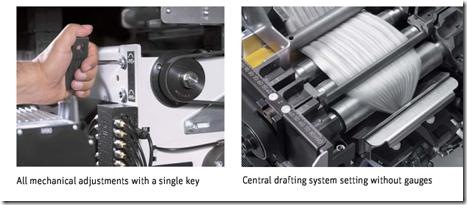
Central setting of roller gaps permits rapid blend changes. Break draft and main draft distances can be set independently of each other for the fi rst time. The roller gaps can be read off a scale, which makes setting gauges unnecessary. The belts can remain tensioned during setting. All mechanical settings can be performed with a single key.
The top rollers are swivel-mounted on the loading arm. This permits optimum accessibility. The sliver is threaded-in with the help of compressed air. The mounting bracket of the web guide nozzle is pivoted, which makes access to the take-off discs considerably easier. All technology components are de­signed so that they can only be used in the correct position. This prevents damage due to incorrect operation.
SHORT FIBER DRAFTING SYSTEM FOR UNIFORM DRAFTING OF SLIVERS CONTAINING VERY SHORT FIBERS
A short fi ber drafting system is also available as an option for processing fi bers less than 1 inch (< 25 mm) long. The even shorter drafting distances – compared with the standard draft­ing system – improve fi ber control and reduce floating fi bers. This has a positive impact on sliver and yarn quality. The use of smaller top rollers with a diameter of 36 mm enables a maxi­mum delivery speed of 550 m/min to be achieved.
clip_image036
CLEANcoil – Innovation in coiling
CLEANCOIL FOR SLIVER COILING WITHOUT DEPOSITS OF FINISHING AGENT
Deposits of fi nishing agent sometimes occur on the underside of the coiler when manmade fi bers and blends are being proc­essed. This has an adverse eff ect on quality values, causes displaced sliver layers or necessitates frequent cleaning. The CLEANcoil coiler resolves the problem with a honeycomb struc­ture on its underside (patent pending), which is being used
for the fi rst time in the textile industry. When polyester is being processed, the cleaning cycle can vary from 2-3 hours to
1-7 days, depending on the type and amount of fi ber fi nish. Even with critical types of manmade fi ber, CLEANcoil guarantees high can capacity, neat sliver coiling and ensures trouble-free sliver running in the subsequent process. CLEANcoil is the new standard coiler for all materials, i.e. also for carded and combed cotton, and off ers maximum fl exibility.
RELIABLE SLIVER SEPARATION WITHOUT ADDITIONAL MECHANICAL DEVICES
Active sliver separation is necessary for trouble-free can chang­ing when processing fi bers with high fi ber/fi ber friction, such as manmade fi bers. The new generation of drawframes makes its mark here with an ingenious solution. A thin place created between the drafting system and the take-off calender roller is transported until it is below the coiler, where it breaks when can change takes place. This solution (patent pending) requires neither additional mechanical devices nor drives as on conven­tional sliver separators. It is included in the machine‘s stand­ard equipment.
Reliability with the Rieter Quality Monitor
CONTINUOUS QUALITY MONITORING
The Rieter Quality Monitor (RQM) reliably prevents the produc­tion of defective slivers. It operates independently of the auto-leveling unit. RQM continuously monitors the thickness of the sliver being delivered via the movable calender disc and stops the drawframe automatically when preset limit values are exceeded.
The calender discs are made from special steel with a low-wear surface coating. The higher precision of the sensor enables the number of sliver tests in the laboratory to be reduced further. RQM shows eight diff erent CV% readings, the A% value, the spectrogram and thick places on the machine display. Connec­tion to Rieter‘s SPIDERweb data collection system is optional for more extensive analyses.
QUALITY DATA COLLECTED BY RQM
· Sliver count (A%)
· Sliver regularity (CV%) and length variation values for 5 cm, 10 cm, 25 cm, 50 cm, 1 m, 3 m and 5 m
· Current spectrogram
· Presentation of quality diagrams for up to 11 days
· Thick places > 2 cm
clip_image038
ADVANTAGES OF THICK PLACE DETECTION
· Monitoring of cleaning and maintenance services on the card, comber and drawframe
· Monitoring of the sliver piecing
· Assistance with technological optimization
· Improving sliver and yarn quality
· Ensuring higher productivity on the roving frame, fi nal spinning machine and winder
RAPID FAULT DIAGNOSIS WITH AUTOHELP
AUTOhelp fault diagnosis results in faster trouble-shooting and ensures high machine availability. When a spectrogram peak occurs, RQM stops the drawframe. Possible causes of faults ar indicated in the gearing layout on the machine display.
FEED SLIVER QUALITY DISPLAY
The A% and CV% readings of the feed slivers can now be dis­played on the RSB-D 40. These values are ascertained by the scanning discs of the autoleveling unit. This helps personnel to detect and analyze defects in the upstream processes.
clip_image040
clip_image042
Control panel
RAPID INFORMATION AND SETTING
The keys on the control panel are labeled with simple, self-explanatory symbols. The display also shows all machine states in pictorial form. This simplifi es the operator‘s work consider­ably.
OVERVIEW OF CONTROL PANEL FUNCTIONS
· User-oriented operation:
1. Basic mode with reduced range of menu and data images
2. Expert mode with all setting options
· Direct selector keys for rapid access to frequently used functions
· MEMOset article management:
1. Rapid batch change via preset parameters
2. Up to 20 diff erent articles can be stored and retrieved
· Detailed display of machine stoppages, their reasons and duration
· Logbook for complete documentation of machine settings (change history)
· Languages: Chinese, English, French, German , Greek, Indonesian, Italian, Portuguese, Russian, Spanish, Thai, Turkish, Urdu
clip_image044
Low maintenance costs
ERGONOMIC, SAFE MACHINE DESIGN
The structure of the drawframe is asymmetrical, i.e. the main components such as scanning, drafting system and coiling are not in the center of the machine, but are off set in the direction of operating personnel. This also simplifi es operating proce­dures for personnel who are not so tall.
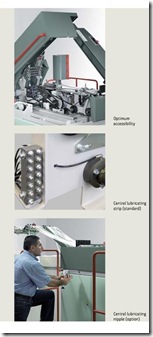
Three hoods open wide to provide optimum access to the main machine components, both from the side and from above. The wide work platform with handrails also improves working con­venience and safety.
RAPID, EASY AND RELIABLE MAINTENANCE
In order to ensure maximum reliability, the drawframe‘s stand­ard equipment includes a central lubricating strip, which sup­plies all the relevant points with lubricant. The lubricating strip is ideally accessible and reduces the risk of important lubrica­tion points being forgotten.
A central, externally accessible lubrication system comprising only one lubricating nipple is also available as an option. In this case the machine signals its lubricating requirements and indicates to maintenance personnel on the control panel the amount of lubricant to be applied. Lubrication can actually be performed while the machine is running.
A further option is fully automated lubrication by means of a built-in pump with a large grease tank, which operates without any intervention by personnel. All central lubrication systems reduce maintenance eff ort and increase operating reliability.
clip_image046
LONG SERVICE LIFE OF COMPONENTS
The movement of air resulting from the pressure prevailing in the interior forces machine heat outward. The reduction in interior temperature and the vibration-optimized machine frame result in long service lives for electronic and mechanical components. All major components involved in fi ber guidance feature an especially resistant Rieter surface coating which ensures a long service life.
ROBUST, SIMPLE DRIVES
With the integrated extraction system the RSB-D 40 requires only four motors, i.e. three robust asynchronous motors and one AC servomotor with inverter. The SB-D 40 has only three asynchronous motors. Compared with other machine concepts, Rieter drawframes therefore need only a fraction of the motors and inverters and thus display higher reliability.
A voltage stabilizer is available as an option in order to ensure that the drawframes remain fully operational, even in the event of short-term fluctuations in mains power.
ENERGY SAVING
Mill trials indicate energy savings of up to 10% compared with the previous model, depending on the quality of the feed sliver. Belt drives instead of complex gear assemblies and the small number of motors and inverters keep energy consumption low. Furthermore, the lower masses being moved in comparison
to the RSB-D 35 and the shorter drive chain reduce energy consumption.
ELECTRONIC DOCUMENTATION
Operating instructions, spare parts catalog and electrical doc­umentation are supplied both as hard copy and in electronic form on CD. User-friendly navigation and 3D illustrations in the electronic documents facilitate rapid location of the required topic. Video fi lms of all major setting operations ensure under­standing and can be used for training personnel. A high level of personnel expertise ensures the quality and productivity of the drawframe.
SLIVERPROFESSIONAL EXPERT SYSTEM
SLIVERprofessional, the proven, machine-independent expert system on CD, is available as an option and provides valuable technological support.
Its main functions are:
· Recommended settings depending on the raw material for the machine as a whole
· Analysis of spectrogram defects: periods and drafting waves
· Managing batch data
· Analytical software in 11 languages: Chinese, Czech, English, French, German, Italian, Portuguese, Russian, Spanish, Turkish and Urdu
· Sphere of application: RSB-D 30/35/40 and SB-D 10/15/40
clip_image048
clip_image050
Sliver feed and can logistics at the delivery end
SLIVER FEED VERSIONS
Drawframe infeed can take the form of positively driven roller feed or a fi xed creel. The supports can be adjusted in height and adapted to the relevant can height. The following sliver feed versions are available depending on the space available in the spinning mill:
· Single or double-row can arrangement for 4 to 8-fold doubling (driven feed)
· Double-row, T-form can arrangement for 8-fold doubling in especially limited space (length) (driven feed); not for combed cotton
· Double-row can arrangement for 6 to 8-fold doubling (creel)
AUTOMATIC CAN CHANGER
All SB-D 40 and RSB-D 40 drawframes are equipped with an automatic rotary can changer. The complete range of cans with diameters from 210 mm to 1 000 mm can be handled. The empty cans are fed reliably on a roller conveyor. An additional motor is unnecessary. The empty can magazine accommodates up to 8 cans, depending on can diameter, which results in long running periods without personnel intervention. When space is limited in terms of machine length, shorter empty can mag­azines can also be chosen. The full cans are ejected onto the
fl oor or onto a can trolley (optional).
clip_image052
CANlink is an economically attractive solution for automatic can transport between two drawframe passages.
The operating principle of CANlink is remarkably simple:
1. The cans are fi lled at the fi rst passage
2. The full cans are automatically ejected into a reserve row
3. After the feed cans in the 2nd passage have been emptied, the reserve cans are pushed manually into the feed position and the empty cans are thus simultaneously ejected into the empty can position. The empty cans are transported automatically back to the 1st passage.
ADVANTAGES OF CANLINK:
· No cans are transported manually
· The top layers of sliver are not damaged by operating personnel
· Confusion between material is prevented
· Effi ciency of the drawframe pair is increased
· Changing time of feed cans is reduced
· Number of cans in circulation is reduced
· Clearly laid-out production lines
clip_image054
The drawframe in the spinning process
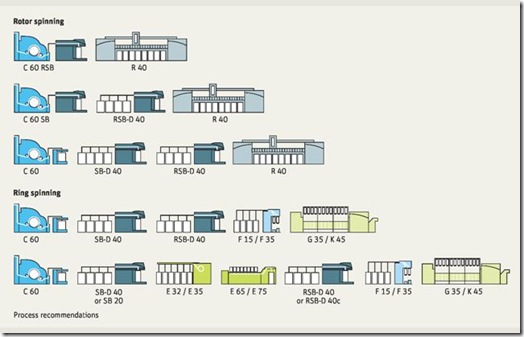
C 60 SB / RSB – BASIS FOR SHORTER PROCESSES
The C 60 card with integrated SB or RSB drawframe module e ables processes to be shortened, especially in rotor spinning. Rieter therefore always off ers the most economical process fo diff erent quality requirements.
RSB-D 40 – FOR SUPERIOR QUALITY, PRODUCTIVITY AND FLEXIBILITY
The RSB-D 40 is the ideal fi nal passage in any spinning prepa­ration operation. Rieter autoleveling technology ensures outstanding running properties in subsequent manufacturing processes and the highest quality standards in the yarn and the end product.
SB-D 40 – THE PERFECT COMPLEMENT TO THE RSB-D 40
The SB-D 40 without autoleveling is the perfect partner for the RSB-D 40 for highly flexible lines operating with maximum effi - ciency. Delivery speed and output are ideally coordinated. The largely identical structure of the two models is an advantage
for operation and maintenance.
RSB-D 40C – AN ALTERNATIVE IN THE RIETER COMBING SET With a maximum delivery speed of 550 m/min, the RSB-D 40c autoleveler drawframe is especially suitable for use after the combing process.
clip_image056
clip_image058
Rieter Machine Works Ltd.
Klosterstrasse 20
CH-8406 Winterthur T +41 52 208 71 71 F +41 52 208 83 20 sales.sys@rieter.com
Read more...

Rieter - Rotor Spinning Machine R 40

clip_image002

clip_image004

The newest R 40 is familiar to you, but it is still a new genera­tion of rotor spinning machines. Many characteristics and nu­merous sub-assemblies of the R 40 have been developed fur­ther and thus the productivity, quality and reliability have been considerably enhanced again. With impressive performance data, 500 spinning positions per machine, up to 350 m/min delivery, rotor speed of up to 160 000 rpm, up to 4 robots, the R 40 off ers maximum productivity.
In addition to well-proven techniques, the newest state of the art technologies have been incorporated for economic produc­tion. Energy, a steadily increasing cost factor in yarn manufac­turing, has been utilized economically and effi ciently. The R 40 energy consumption has been lowered signifi cantly by invest­ing in the most modern inverter technology, power-saving mo­tors and innovative bearing and lubrication techniques. The unique performance data guarantee the highest productivity and off er adequate potential for technical and technological developments in the future. The most modern techniques and technologies are implemented rigorously for the purposes of economic production: An objective which has received top pri­ority in development at Rieter.
With the R 40 rotor spinning machine and with Rieter as your partner, you are well equipped for the future.


clip_image006
PRODUCTIVITY
Reliability through process safety
With this newest model, the R 40 off ers up to 500 spinning posi­tions per machine. This makes it the longest spinning machine in the world. With the maximum machine length, delivery speeds of up to 270 m/min are possible. Using fewer spinning positions, 350 m/min can be obtained. Rotor speeds of up to 160 000 rpm, independent of the machine length, enable highest production rates. The new R 40 combines maximum productivity with mini­mum personnel requirements and high machine effi ciency.
COMPATIBLE MACHINE CONCEPT
The outstanding technical data of the R 40 are combined into
a modern machine concept. The fast robots of the R 40 with its modules, AEROpiecing, and the eXpert Piecing System XPS, form the back-bone of the R 40 automation.
Large units for material supply and package removal, a fast tube loader and interfaces for a central waste disposal systems make the R 40 complete.
INCREASED MACHINE RUNNING TIMES
The new R 40 uses frequency controlled inverters for all the cen­tral drives. Thus a lot change can be carried out entirely from the touch-screen of the machine control center. The production loss is reduced to a bare minimum. Long maintenance intervals and easy accessibility shorten the machine down-time and increase the productivity of the R 40.
SC-R SPINNING BOX, UNEQUALLED IN ITS POWER
The particular power of the SC-R spinning box lies in the box geometry and the various technology parts available for all mate­rials. Best values in yarn quality and productivity are achieved.
New rotors and nozzles have been developed through working together with leading man-made fi ber manufacturers. As a result it is possible, for example, to spin viscose fi bers from one manufacturer to a yarn count Ne 16 with 160 000 rpm and 350 m/min delivery speed. The core capability of the spinning box and the spinning elements are incorporated under one roof.
The costs under control
The economics of a machine are defi ned by the accrued costs per kg of yarn produced, i.e. investment costs, the raw materi­al supplied, energy and compressed air consumed, the climate control, along with building and personnel. With up to 500 spinning positions, the R 40 off ers the best space utilization with the largest sliver cans and package sizes.


SOLID LONG TERM INVESTMENT
In addition to the machine productivity, its service lifetime has a major eff ect on the economics. High value components from lead­ing suppliers, modern bearing and drive technology as well as a robust machine construction guarantee a long useful lifetime.
One Rieter development team is responsible exclusively for modifi cations of older machine generations. The newest devel­opments and techniques can thus also be transferred to older machine models. This maintains the competitiveness of Rieter rotor spinning machines and result in attractive resale values.
MORE POWER WITH LESS ENERGY
The new R 40 consumes less power energy thanks to the invert­er-controlled drives. The improved bearing technology of the spinning box and the drives result in energy savings of more than 5% compared with other rotor spinning machines.
LARGE QUANTITIES OF MATERIAL AT LOW COST
The large can and package sizes reduce the costs for material handling and waste disposal. The spinning position gauge per­mits can sizes of up to 470 mm (181/2”) in a straight two-row arrangement for processing larger quantities of sliver material. The optimized winding geometry can produce package weights of up 6 kg (350 mm diameter) and reduces the operator re­quirements.
BEST RAW MATERIAL EXPLOITATION
The SC-R spinning box includes patented special features such as the fi xed fi ber support, the adjustable BYpass and the SPEED-pass. These features permit the production of high quality yarn values, even when utilizing lower raw material qualities.
clip_image008
clip_image010
Rapid reaction to market trends
The R 40 allows quick reaction to the market needs of custom­ers. A condition for a successful spinning mill is a high flexibil­ity and maximum machine availability. Various applications of yarns can be spun effi ciently on the R 40: regular and eff ect
yarns, weaving and knitting yarns, using diff erent raw materials and their blends.
CHANGE-OVER AT THE TOUCH OF A BUTTON
VARIOdraft permits draft, rotor speed, winding draft and yarn twist to be set comfortably at the central machine display. Additional functions such as the variable opening roller speed,
clip_image012
winding with the VSB traverse gear box, anti patterning and winding angle can now be set simply on the touch screen. The time it takes for a lot change is reduced to a minimum using the VARIOdraft functions.
OPTIMIZATION WITH THE MACHINE RUNNING
As a result of controlling all drives with frequency inverters the spinning parameters can also be optimized during production. This permits maximum productivity and flexibility.
OPTIMAL ADJUSTMENT TO RAW MATERIALS
The modern SC-R spinning box of the R 40 allows the manufac­turing of natural and man-made fi bers with high quality charac­teristics. A wide range of technology parts are available for the R 40. From a universal spinning elements for a broad applica­tion spectrum to special spinning elements for specifi c applica­tions with highest demands.
RETROFITTING ANTICIPATED IN THE CONCEPT
You can react flexibly to future economic developments with the R 40. For example, the personnel costs can be signifi cantly reduced with the optional installation of centralized supply and removal systems. The R 40 can be fi tted with a slub yarn device to produce yarns for fashion trends.
clip_image014
R 40 sets the standards
The R 40 produces high quality yarns with the proven SC-R spinning box. Modern yarn clearers check the quality continu­ously within very narrow limits. Production and quality data are collected with the SPIDERweb data collection system, ed­ited and then displayed on the central PC. This networking per­mits an immediate intervention for the smallest deviation from the quality standard.
NEWEST TECHNOLOGY FOR THE BEST RESULTS
The SC-R spinning box with the fi xed fi ber beard support, the BYpass, and the SPEEDpass, form the basis for the produc­tion of the best quality R 40 rotor yarns. The operation of yarn clearers assures the quality of the yarn produced. With 100% testing, including the piecings, a continuous high standard is guaranteed.
clip_image016
PIECING QUALITY EQUAL TO THE YARN
AEROpiecing, the revolutionary piecing technology in the R 40, allows the production of rotor yarns with short, invisible piec­ing. This continuously high yarn quality is a condition for the best running properties in subsequent processes and for high quality end products.
PIONEERING ROTOR CLEANING
Only a cleaned rotor can produce piecings of the same quality as the yarn. The patented rotor cleaning VARIOclean is clean­ing the rotor groove and the rotor walls reliably from all trash, dust and fi ber fi nish.
MORE CONSISTENT PACKAGE BUILD FOR DOWNSTREAM PROCESSING
The outstanding package build up with electronically meas­ured exact yarn length has a very low variability from package to package. When supplemented by REDIpac to defi ne the loca­tion of the yarn end, the customers profi t from optimal package handling, best running properties and an exact yarn length.
clip_image018
clip_image020
SPINNING BOX TECHNOLOGY
Highest performance for productivity and yarn quality
Over 30 years of experience with the development teams at SUssen and Rieter are invested in the SC-R spinning box. Con­sistently high yarn quality from spinning box to spinning box as well as optimization with respect to raw materials are only
a couple of the advantages.
SC-R SPINNING BOX WITH NEWEST TECHNOLOGY Technologically, the SC-R spinning box off ers unique charac­teristics. With the fi xed fi ber-beard support in the area of the sliver feed, a homogeneous sliver opening is guaranteed and achieves a yarn quality with minimal variability. The trash ex­traction is adjusted over the BYpass. Optimum trash elimina­tion, low fi ber breakage and the highest productivity are the recognizable characteristics of the BYpass.
In addition to the standard version of the channel insert, there is one with SPEEDpass available for spinning man-made fi bers and coarse cotton yarns. The SPEEDpass permits more air to be pulled through the fi ber channel. This enhances the fi ber sepa­ration at the opening rollers and the stretched transport of the fi bers into the rotor. Residue is removed from the material fl ow over the SPEEDpass. As a result, the rotor grooves, which im­pact the yarn quality decisively, remain clean.
clip_image022
EASILY REPLACED OPENING UNIT
An additional opening unit is available for the SC-R spinning box. Cotton and blended yarns of the highest quality are spun with the universal opening unit. The special opening unit has vital advantages for critical applications with man-made fi bers. Alterations in the region of fi ber separation allow, e.g., polyes­ter yarns for awning fabrics and abrasive base cloth to be spun to highest quality.
OPTIMIZED SPINNING GEOMETRY
In addition to the spinning box itself, its location in the ma­chine is important. This spinning geometry defi nes the spinning stability. The SC-R spinning box arrangement has been selected so, that an increased twist is applied between the TWISTstop and the rotor grooves resulting in increased yarn strength. The application of aggressive TWISTstop elements which roughen and aff ect the yarn surface negatively is seldom necessary. At the same ends down level, the yarn twist can be reduced for a higher productivity.
ENERGY-SAVING CLEAN ROTOR BEARING
The R 40 AERObearing has been developed further and has se­cure and stable running behavior; it holds the rotor in position and avoids any mechanical contact. There is no grease or oil
in the entire bearing area, i.e. no fi bers can get caught in the bearing. The air stream keeps this area of the bearing clean and cool. In reality, this results in extended cleaning intervals of the R 40.
Modern spinning elements for best results
The technology parts of the rotor spinning box defi ne the yarn characteristics. For the R 40, rotors, opening rollers and nozzles are available either for specially defi ned applications or as uni­versally applicable yarns.
NEW SURFACES FOR DRAW-OFF NOZZLES
Nozzles defi ne not only the yarn properties, but also the spin­ning behavior through their characteristics – smooth, with notches or with spirals – and through the material used and its surface fi nishes.
A new development is the innovative „nano4“ nozzle. The draw-off nozzle is fabricated from a special, very fi ne grained ceramic. This nano4 nozzle off ers productivity increases of more than 10% when processing viscose fi bers, due to an optimized friction behavior.
ENERGY-SAVING ROTOR DESIGN
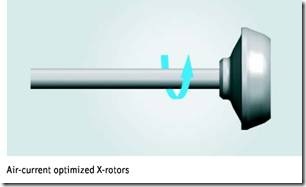
The importance of energy costs as part of the production costs is increasing. A new generation of energy-saving rotors, termed X-Rotors, has an optimized external contour and reduces meas­urably the energy consumption in rotor operations. They con­sume 2-5 watts per rotor, i.e. 1-2% less energy compared to the previous rotor generation, under comparable working con­ditions.
OPTIMIZED VARIANTS FOR OPENING ROLLERS
There is a choice for opening rollers between the well-known solid-ring and the proven wire clothing. The R 40 off ers spe­cialized clothing for cotton, polyester, viscose and their blends for an optimal opening of the feed sliver to individual fi bers. In addition there are opening rollers which can be used universal­ly. Diff erent coatings ensure the best yarn values with a maxi­mum clothing service life.
SPECIAL OR UNIVERSAL CONFIGURATION
Based on the experience of our technologists, we have com­piled designer spinning elements for yarn applications such as denim or polyester yarns for the most advanced require­ments. Universally applicable spinning elements are available for standard applications. Various types of yarns for weaving
or knitting, e.g. viscose or cotton, can be spun nearly optimally with such a set of technology parts.
clip_image024
Simple to set and to operate
Labor intensive and long lot changing times are a thing of the past with the new R 40. The inverter technology which has been introduced makes it possible to perform all settings com­fortably and rapidly on the large touch-screen of the machine center. Specifi c requirements from the technicians, as well as large can and package sizes result in long machine running times without operator costs.
INVERTER-CONTROLLED CENTRAL DRIVES
Modern inverter technology has been implemented consistently into the new R 40. All drives can be set centrally and are infi - nitely variable. This standard sets new benchmarks for operat­ing the R 40. The easy settings of all machine parameters bring advantages at the start of a lot and during the optimization of currently-running production.
COMFORTABLE SETTINGS
All machine settings are made on the touch-screen of the ma­chine center. Opening roller speeds, winding angle, tension draft and anti patterning can be set comfortably and quickly at the machine center. The traversing stroke can be set for the VSB gear box on the machine display, and the package build adjusted to very diff erent yarn numbers.
SPECIFIC 3-STEP OPERATOR GUIDE
The visualization concept of the R 40 is well-thought out and guides the operator objectively. Personnel are called precisely to the R 40 with a three colored signal lamps at both machine ends. The settings of this signaling can be selected individually for the spinning mill organization. It acts as the initial indicator, e.g. for removing packages, repairing a robot or for a machine malfunction.
A lamp at the section indicates either a malfunction at a spin­ning position or a missing sliver. Two colored LED‘s at the in­dividual spinning position signal whether the robot could not piece up or whether a technical alarm exists.
LARGE YARN PACKAGES FOR CONTINUOUS OPERATION Packages of 6 kg or up to 350 mm in diameter set the standard. Then there are 18 1/2“ sliver cans in two straight rows, 20“ in three rows, or CUBIcans with, e.g. 30 kg capacity for longest running times.
clip_image026
clip_image028
FASTEST ROBOT
· Yarn-like piecing with AEROpiecing technology
· Extremely effi cient robots with the shortest piecing time
· Simplest robot setting with XPS
· Travel of the robot is optimized using the intelligent Drive System iDS
HIGHEST PRODUCTIVITY
· Machine lengths up to 500 rotors with rotor speeds up to 160 000 rpm
· Lower energy consumption through inverter technology and AERObearing at high productivity
· Minimal operator costs, using large can and package sizes of up to 6 kg (350 mm)
· Superb package build at delivery speeds up to 350 m/min maximum
clip_image030
clip_image032
clip_image034
BEST YARN QUALITY
· Best running performance resulting from the adjustable trash extraction with the BYpass
· Highest yarn quality from the fi xed fi ber-beard support and the SPEEDpass
· Broad spinning component palette for optimal yarn construc­tion
· Unequalled yarn quality with man-made fi bers with the special opener unit
MAXIMUM FLEXIBILITY
· Inverter operation for rapid lot change and optimization of quality and productivity while the machine is running
· 1, 2, 3 or 4 robots with service stations for eff ective robot service
· Flexible through the overlapping of the robot working areas, which can be set at the machine center
· Slub yarn, Multicount and Multitwist are possible, as an additional feature, at full machine length
clip_image036
clip_image038
ROBOT AUTOMATIZATION
Speed and precision for productivity and quality
Together with the spinning box, the robot is of central impor­tance. The yarn quality in the area of a piecing, as well as the machine effi ciency, and thus the productivity, are impacted by the robot.
SHORT STOP AT THE SPINNING POSITION
The R 40 robot conducts many individual tasks at the spinning position, e.g., changing full packages, placing empty tubes, cleaning the rotor, and feeding the yarn into the rotor. The stop at the spinning position only lasts 25 seconds. Modern robot control permits parallel module operation at maximum speed. The short cycle time makes it possible for the same number of robots to service more spinning positions without any reduction in machine effi ciency.
LASER GUIDED POSITIONING
Centering on the spinning position with millimeter precision cannot be guaranteed using mechanical methods over extend­ed periods. Using the new, high precision, laser-controlled centering on the new R 40, this is both reliable and possible without any wear occurring. The robot stops precisely at each spinning position. Reliably and accurately, the robots carry out the piecing operations.
EFFICIENT ROTOR CLEANING
An effi cient rotor cleaning is a precondition for optimum piecing quality. Potential sources of problems, such as, e.g. trash particles in the rotor grooves must be removed effi ciently. Rieter follows a new path with the patented VARIOclean rotor cleaning. A rotating cleaning head with two scrapers and three compressed air jets nozzles is brought into the rotor. The rotor groove is are cleaned out with the scrapers and, in addition, the rotor groove and the entire rotor wall is cleaned by compressed air. Clean rotors guarantee quality piecings and yarn quality.
SIMPLE SETTINGS WITH XPS
The conditions for an optimal piecing quality are set with VARIOclean and AEROpiecing.
Using XPS, the eXpert Piecing System, the robot is set up in an instant. The data for a lot change are transmitted from the ma­chine center to the robot. Only the fi ber material to be spun must be selected at the robot. For the remaining 6 parameters in the expert system, the robot refers back to the data base of thousands of stored robot settings. The XPS suggest settings for the 6 parameters and these can be accepted by pressing
a button. The robot then operates at high effi ciency and with yarn-like piecing quality. A possible fi ne tuning, such as the ad­justment of the twist or the mass, is carried out by simply ad­justing some of these 6 parameters.
PIECING QUALITY REMAINS THE SAME
The robot controls and monitors the piecing procedure and thus assures that the procedure remains the same. The innova­tive AEROpiecing concept which feeds the yarn tail of defi ned length into the rotor from pneumatic storage is the key to a consistently good piecing quality.
PROBLEM-FREE MAINTENANCE
The modular construction of the robot allows easy maintenance. Each module can be moved independently, manually or by using the robot control system. Making mechanical settings for the ro­bot, and the removal of any malfunctions is extremely simple,
and this success motivates the technicians to give their best performance. With simple malfunctions, the robot cycle is sim­ply stopped; the robot goes back to its initial position independ­ently and moves on to the next spinning position. The feedback from the R 40 technicians is overwhelmingly positive; based upon more than 1 500 R 40 robots which are running in the
fi eld. Rapid coordination and simple maintenance, successful re­moval of malfunctions are only a few of the advantages quoted.
LARGE GRAPHIC DISPLAY
All piecing parameters are shown clearly on the robot display. Robot effi ciency and further information can be called up quickly.
clip_image040
clip_image042
The successful R 40 machine concept is designed for high pro­ductivity with a maximum machine length.
MORE FLEXIBILITY WITH 4 ROBOTS
The R 40, with a length of up to 500 rotors can be equipped with up to 4 robots. Each robot is assigned to a certain posi­tion from the maintenance concept. All spinning positions are served by the remaining robots while one robot is in mainte­nance. There is no loss of effi ciency. The working area of the robots are assigned at the machine center and can overlap. The intelligent Drive System iDS off ers a further optimization. The machine center coordinates the robot travel area and thus opti­mizes the effi ciency of the entire machine.
RELIABLE AND SERVICE- FRIENDLY ELECTRONICS
The running speeds are monitored by the inverter and addition­ally by sensors mounted on the drive shafts. Any deviations are recognized immediately by this double monitoring system ar­rangement and the machine is stopped. Thus the production of inferior yarn quality is avoided.
EXTENDED CLEANING INTERVALS
Many improvements have been made to extend the cleaning in­tervals of the new R 40. These improvements save 1 to 2 clean­ing intervals annually and thus increase the productivity time signifi cantly.
· AERObearing, grease and oil free
· SC-R spinning box with the best self-cleaning
· Robots with the VARIOclean rotor cleaning
· Central lubrication feature
ENERGY CONSUMPTION
Maximum output with effi cient energy utilization
The increasing energy requirements world-wide are leading to steadily increasing costs. For many years Rieter has placed the topic of energy savings in the foreground of new developments. The R 40 energy requirements have been reduced steadily over previous machine generations with a parallel increase in pro­ductivity.
INVERTER AND ENERGY-SAVING MOTORS
The integration of inverters combined with the central drive of the R 40 has permitted the elimination of gear boxes. This way, power is transmitted directly without loss. The energy con­sumption has been reduced further by using modern, energy-saving motors. The energy requirements of the new R 40 have been reduced by 7%.
ENERGY-SAVING BEARINGS AND LUBRICATION
A further area for saving energy is in the bearing technology and the use of lubrication. Rieter took advantage of the exper­tise of innovative partners for the R 40. These bearings have the best running properties and are energy-economical. Mod­ern bearing technology, combined with high effi ciency lubri­cants is an important module for reducing energy consumption.
NEW ROTOR GENERATION
The performance of the new x-rotors have been enhanced con­siderably compared with conventional rotors: Up to 12% high­er speeds and up to 5 watts lower energy consumption, and with better acceleration and braking performance. The key to these developments is extensive computer simulations and an ISO certifi ed fabrication process.
clip_image044
ENERGY EFFICIENT VACUUM SYSTEM
The fan, used to generate the vacuum in a rotor spinning ma­chine, is the second largest energy consumer. The vacuum lev­el is infl uenced by the build up of the fi lter mat. With the R 40, Rieter is the sole manufacturer to follow the route of combat­ing the problem at the source. When the fi lter gets clogged, the vacuum falls. The machine control system starts an eff ective fi l-ter cleaning process automatically as a function of the vacuum level. The set vacuum level is again operative after this clean­ing cycle. The vacuum remains constant with unchanged low energy consumption by its highly effi cient main fan. As an op­tion, the waste in the fi lter boxes can be removed centrally and automatically.
clip_image046
Cooperation with specialists
The R 40 rotor spinning machine combines large numbers of functions and systems. Yarn clearers and slub yarn devices are examples of advanced technology sub-systems. Rieter takes ad­vantage of the knowledge of specialized suppliers for these op­tions.
YARN CLEARER SYSTEMS FOR ALL REQUIREMENTS
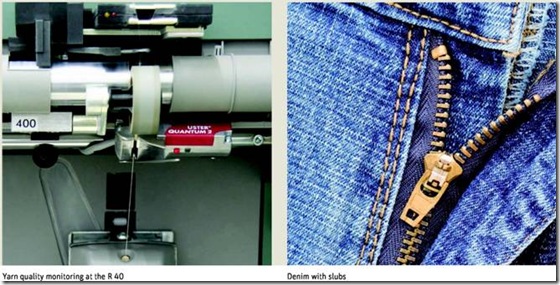
Yarn clearers are an absolute necessity for modern rotor spin­ning machines. These monitor the yarn in terms of its quality within predefi ned limits. The Quantum Clearer 2 from Uster with optical or capacitative sensor or the Barco yarn clean­er with optical sensor are available for the R 40. Both can be equipped with the foreign fi ber detection option. The R 40 re­places the recognized yarn faults with yarn-like AEROpiecing piecings of the highest quality.
SLUB YARN DEVICES FROM WELL-KNOWN MANUFACTURERS Current fashions defi ne which yarns can be off ered successfully on the market. The demand for slub yarn remains high. The simplest way to create an eff ect in the yarn is by using a special opening roller. These generate eff ects which are smaller than the rotor diameter, and which are random and not programmable. Working with Amsler and Caipo as partners, Rieter off ers a se­lection of two eff ect yarn devices for the R 40. Soft and hard­ware interfaces are defi ned. Fitting can be carried out easily and secure. The R 40 can be supplied from the factory with a Caipo device for slub yarn, multi-count and multi-twist.
AUTOMATION POTENTIAL FOR PACKAGE REMOVAL
The removal of the produced yarn packages has a steadily in­creasing importance as deliveries increase. The R 40 off ers a universal interface to adapt the central package removal or pal­letizing systems. These systems support productivity and guar­antee independence from operator availability.
clip_image048
CENTRAL TRASH DISPOSAL
The R 40 now has a very generously dimensioned fi lter box for the disposal of trash from the spinning process, and separate­ly from the robot. Both fi lter boxes are prepared for connecting up to a central trash disposal system. Specialized suppliers can connect their systems and control the trash disposal centrally. Operating personnel are relieved of this task, enhancing the productivity of the machine.
BEARING AND DRIVE TECHNOLOGY
Drive technology becomes more signifi cant as the spinning ma­chines get longer. The drives must operate reliably, consume little energy and permit a secure control by the machine control system. Energy saving motors, quality bearings and lubricants lower the energy consumption on the R 40. On these topics, Rieter also guarantees its customers the know-how of interna­tional specialists through close collaboration.
AUTOMATED SPINNING MILLS
CUBIcan cans contain large quantities of sliver. Transportation units without a driver -AGV’s- can move these to the R 40 auto­matically. The transportation units exchange full CUBIcans for empty ones. The R 40 robots are equipped with an additional module, the ROBOfeed. Using this, the robot takes the sliver from the can, brings it into the spinning position and starts the spinning process.
Automatic set-ups are frequently encountered in package re­moval. Systems collect the packages from the machines for a centralized or decentralized palletizing. Such systems have al­ready been installed in many R 40 spinning mills.
LATER RETROFITTING POSSIBLE
The technical and technological development of rotor spinning strides forward. The needs and requirements of the market change and our customers must be able to react to these. New developments are constructed in such a way that they can be retro-fi tted to older versions if at all possible. These upgrades off er advantages to the customer in terms of productivity, yarn quality and machine service life.
clip_image050
clip_image052
Quality has a name
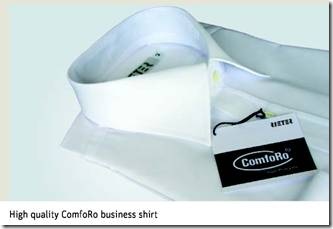
Rieter has established a name for the rotor yarns from the R 40. the trademark ComfoRo®. Rieter has built partnerships with leading suppliers of the textile chain. Together, experience and know-how have been gathered, covering the entire downstream processing. This know-how is made available to our customers. Yarns are produced and designed for the fi nal product, and thus off er a decisive market advantage. ComfoRo® yarns are con­quering the new markets in Asia. Articles which until now have only been produced exclusively locally with ring-spun yarn can now be replaced with more economically produced ComfoRo® yarns.
UNIQUE YARN QUALITY
ComfoRo® is based on the unique yarn quality of the SC-R spin­ning box and the yarn-like piecings with AEROpiecing technol­ogy. Thanks to XPS this high piecing quality can be achieved easily and safely. ComfoRo® yarn is characterized by the best properties in the downstream processing.
PRE-SET YARN CHARACTERISTICS
The yarn must already be produced with the defi ned required profi le for an optimum result to be achieved in the end prod­uct. Here not only the know-how from Rieter is necessary, but this must flow together with that from the partner in the down­stream processing. Yarn properties and yarn characteristics are optimized by the selection of spinning elements suitable fort the application. The ComfoRo® rotor yarn is optimized for the following process and thus delivers the best results in the fi nal product.
ECONOMICAL ComfoRo® PROCESS
The production costs per kg of yarn play an important role. Sig­nifi cantly fewer machines with maximum productivity, reduced power consumption and space requirements, less operating and maintenance personnel are characteristics of the Rieter ro­tor spinning mill.
ECONOMICS FOR THE DOWNSTREAM PROCESSING
ComfoRo® weaving yarns are characterized by good unwinding behavior, low sizing pick up, and cause low fl uff on high per­formance weaving machines. ComfoRo® knitting yarns are characterized by a defi ned hairiness and low twist. A multiplic­ity of short fi bers guarantees a good unwinding behavior for waxed yarns, and a pleasant soft hand. The hand, the softness can be improved further by using fi nishing technologies. ComfoRo® yarns, and high value products made from them, are enjoying a steadily increasing appreciation in the market­place. Further information on ComfoRo® can be found under http://www.comforo.com/
clip_image054
Production units with low energy consumption
Compact production units such as the Rieter Rotor System of­fer the best opportunity for the best productivity with low en­ergy requirements. Highly productive machines from the blow room through the rotor spinning machine R 40 require fewer machines, use less space, and lower the costs of air condition­ing and illumination.
HIGH PRODUCTIVITY, MINIMAL SPACE REQUIREMENTS
The Rieter Rotor System stands for an appropriate maximum productivity with low space requirements. From the direct proc ess, i.e. card C 60 with an integrated RSB module, or through the classical process with 2 drawing passages for fi ne yarn of the highest quality, the Rieter Rotor System off ers all options. Rieter machines have low energy and space requirements for maximized productivity. The production costs per kilogram of yarn are at a signifi cantly low level.
AIR CONDITIONING
The high production machines in a Rieter spinning mill need less space. Energy saving machines emit less heat into the sur­roundings. With fewer machines in combination with a com­pact building, the costs for air conditioning are signifi cant-
ly lower than for conventional systems. Savings of more than 10% can be achieved.
LONGTERM POWER BRIDGING
Our customers rely increasingly on the system for uninterrupt­ed power supply UPS. These units avoid power interruptions in the spinning mill reliably and maintain high quality. An R 40 system fi tted with UPS, continues to operate without any qual­ity or production variations. Maximum productivity without ad­ditional piecings on the package is guaranteed. The UPS units become amortized within a year and prevail rapidly in critical markets.
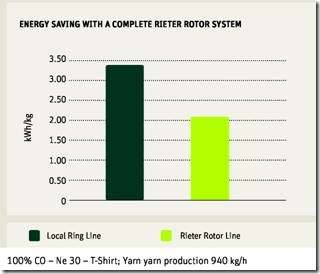
100% CO – Ne 30 – T-Shirt; yarn production 940 kg/h
1 x 11 x 5 x 5 x 12 x
Blowroom Card Drawframe Drawframe R 40 - 440
95 kg/h 850 m/min 850 m/min 125 000 rpm
C 60 SB 20 RSB-D 40
5 250 qm Less space than the local ring line
Rieter Rotor System with highest productivity and lowest required space
Young process with potential for the future
The fi rst commercial rotor spinning machine was exhibited at the ITMA in Basel only 40 years ago. One can rightly speak of a young spinning process. The developments during this pe­riod were fast-paced: rotor speeds and delivery speeds were increased considerably, yarn counts up to Ne 60 are possible, and all types of raw materials can be processed.
CREATIVITY AND EXPERTISE
The R 40 machine control system with the Can-Bus system is more powerful than the fi rst spacecraft. Mechanical compo­nents are made from novel materials, stronger and more dura­ble than ever before.
The standards set for all these advances in development re­main the reliability and controllability. With the R 40, Rieter demonstrates a balanced combination of practical technology conversion and controlled processing.
YESTERDAY’S VISION, TODAY’S REALITY
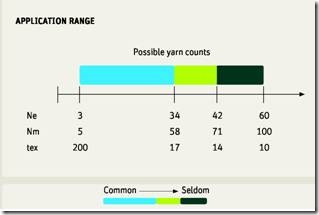
Even just a few years ago it would have been unthinkable to pro­duce viscose at speeds of over 300 m/min on a rotor spinning machine. With the R 40, Rieter demonstrates impressively just how development can break down such boundaries. Today a yarn Ne 16 is running viably at 350 m/min with a rotor speed of 160 000 rpm. Viscose yarns are being spun commercially and successfully on the R 40 up to Ne 60. Novel fi bers such as bam­boo are a regular part of the production program on the R 40.
COOPERATION WITH FIBER MANUFACTURERS
Rieter is working on future-oriented developments together with leading fi ber manufacturers. Fiber, avivage and spinning com­ponent developments are being pursued together. As new fi b­ers become available on the market, Rieter already knows which spinning components and settings are required on the R 40.
TECHNOLOGY PARTS FROM THE LABORATORY TO THE CUSTOMER
The development of new technology parts begins with an idea or a requirement from the marketplace. Small series are tested at Rieters spin center in extensive spinning tests. Working with interested customers, Rieter carries out further spinning trials and supports the development of new products. The tests are, if at all possible, pursued through the various steps in the
downstream processing.
clip_image056
ROOM FOR VISION
Ideas for the next generation begin to mature even during the work involved in implementing a new machine. In close collab­oration with Institutes and Universities new visions are born, discussed, rejected or confi rmed. Basic testing is carried out, redefi ned and refi ned. As a machine manufacturer, Rieter is in­terested in off ering special solutions to its customers, which cannot be obtained from other manufacturers.
TRAINING AND EDUCATION OF PROFESSIONAL STAFF
The productivity of new machines and equipment, and fi nally the quality of the product, depends on the personnel. Operators who are well educated and trained on the machines can use the Rieter rotor equipment more effi ciently. Therefore Rieter puts high value on education and training. Specialists instruct per­sonnel in Europe or directly on-site at the customer with in-mill training. All aspects are taught intensively, from operation through maintenance and problem-solving.
MODERNIZING AND VALUE CONSERVATION
The possibility of adapting new developments to existing Rieter rotor spinning machines provides for reliability, increasing pro­ductivity and enhanced yarn quality in existing equipment also.
OPEN TO IDEAS
Suggestions and wishes from our customers are trend set-
ters for each new development at Rieter. They operate the ma­chines, are in the market, see and recognize trends, and must be able to assert themselves in the marketplace with innova­tions. All Rieter staff involved, such as sales personnel, product managers, service technicians, technologists, encourage con­tact with our customers. In discussions, suggestions and needs are formulated for further development activities. Networking with our customers and their clients, and with major partners from fi ber manufacturing and downstream processing, Rieter has built an innovative team with the common objective of achieving the optimum for all those involved.
clip_image058
clip_image060
Rieter Machine Works Ltd.
Klosterstrasse 20
CH-8406 Winterthur T +41 52 208 71 71 F +41 52 208 83 20 sales.sys@rieter.com
Read more...