Showing posts with label Textile industry. Show all posts

Textile Industry in Bangladesh

The Current Position of the Textile Industry in Bangladesh

Textiles have been an extremely important part of Bangladesh's economy for a very long time for a number of reasons. The textile industry is concerned with meeting the demand for clothing, which is a basic necessity of life. It is an industry that is more labor intensive than any other in Bangladesh, and thus plays a critical role in providing employment for people. Currently, the textile industry accounts for 45% of all industrial employment in the country and contributes 5% of the total national income.

Today, the textile industry of Bangladesh can be divided into the three main categories: the public sector, handloom sector, and the organized private sector. Each of these sectors has its advantages and disadvantages. Currently, the organized private sector dominates, and is also expanding at the fastest rate.

Public Sector

The public sector is that portion of the industry controlled by organizations that are part of the government. The factories in the public sector enjoy certain privileges such as government funding. However, in Bangladesh, factories in the public sector are not well supervised. There are frequent changes in officers, and many of these officials do not have a personal interest in the factory for which they are responsible. In addition, the equipment in this sector is not well maintained, as much of the money allocated for this purpose is not spent as planned, but is wasted through corruption and poor accounting.

Handloom Sector

The rural group of textile producers includes operators of handlooms and a number of organizations which employ rural women, such as BRAC, or the Bangladesh Rural Advancement Committee. The Handloom industry provides employment for a large segment of the population of Bangladesh. The industry also supplies a large portion of the fabric required by the local market. Factories in this sector are usually well looked after by the owners and are quite productive, considering the equipment available. However, the inferiority of their machinery, mostly due to their narrow width, means that the fabric production is slow, and usually falls short of the quality needed for export.

Private Sector

The most productive of the three categories is the private sector. This, as the term suggests, is made up of those factories owned by companies or entrepreneurs. Since the owners of such factories are directly affected by their performance, they take an active part in planning, decision making, and management. Most of these factories also have machinery that is superior to those in the two other sectors because the owners are well aware of the connection between their equipment and their profits.

Future Challenge

In future, some of the international policies regarding the export of textiles and garments will change, which may present the Bangladeshi textile industry the greatest challenges it has had to face so far. There is much speculation at present about the situation of the RMG (Ready Made Garment) exporters in the post-MFA (Multi-Fiber Arrangements) period, when the World Trade Organization, or WTO, instead of GATT (General Agreement on Tariff and Trade) will control the sector. Under the WTO all quotas will be removed, resulting in a free market worldwide.

Bangladesh's garment and textile manufacturers will have to face steep competition from countries such as India, Pakistan, China, and Thailand, from whom the country now imports fabric to meet the demands of its RMG sector. When the WTO free market is established, all these countries will be able to expand their RMG exports, now limited by quotas. As a result, these countries will be able to utilize more of their locally produced yarn and fabrics internally, resulting in the rise of prices for these in the export market, putting pressure on the industries of countries such as Bangladesh.

clip_image002

clip_image004

Technical Overview

Number of units:

There are two units:

1. Local unit

2. Export unit.

Machines Used:

a) Blow room:

1. RIETER UNIFLOC A11

Suction velocity: 14 m/min.

2. RIETER UNIFLEX B60

With 6 chambers and suit fit are given.

b) Carding room:

1. Carding machine: RIETER C-51

Production rate: 60 kg/hour.

2. Breaker drawing Machine: RIETER SB-D10 Capacity: 700 m/min.

c) Simplex Machine:

TOYOTA FL100

Flyer revolution: 1050 rpm

Delivery Speed: 21.9 m/min

d) Ring Frame:

JINGWEI

Japan.

e) Auto Conner:

Specification: Type: RM, 12 bar, 61 A, 50 Hz Made in: Germany

f) Yarn Conditioning Plant:

Specification: Capacity: 1200 Kg/hr

Country of origin: India.

Sources of bale:

Bales used by the industry are imported from Holland, Russia, USA.

Power:

As the power source gas generators are used. No. of gas generators: 4

Capacity: 950kw each.

3 shift duty.

No co-generation is implemented.

Humidity:

The humidity maintained at various parts of the factory are as follows. Blow room and carding room: 54% to 55%

Ring room: 55% to 56%

Total Production of the factory:

The total production of the factory is about 1050 Kg/day. The efficiency of various processes are:

Carding : 96% to 97%

Drawing : 85%

Ring : 94% to 95%

Finishing : 82%

Air Conditioning Plant:

Not much information regarding this plant was obtained. No chillers are used here.

Quality Control Management:

Here in this industry the Quality Control is managed in every step of the production process. The speciality of its management is that in every stage of production every lot is being checked. Even in case of purchasing bales of cotton every bale is being checked.

Description of different Processes: BLOW ROOM:

There are four machines for blending, opening, and cleaning.

UNIFLOC:

· The compressed mass of raw fiber is removed from the bales.

· Fine particles of metals are detected in the metal detector.

· Opening is necessary to lessen hard lumps of fiber & disentangle them

· Blending is necessary so as to obtain uniformity of the fiber.

UNICLEAN:

· Removes trash such as dirt, leaves, burs & any remaining seeds

· Prepare the fiber for spinning into yarn

clip_image006

UNIMIX:

· Fibers of different staple length are mixed here.

· Mixing is mainly done to reduce the cost.

· Fibers come in six lanes then mixed by betting.

UNIFLEX:

· Fine betting is done

· Waste product are separated

· Waste id not used but sold

CARDING:

· Initial process of arranging the fiber in a parallel fashion is known as carding, and is done on a carding machine.

· The lap is passed through a beater section and drawn on a rapidly revolving cylinder covered with very fine hooks or wire brushes.

· A moving belt of wire brushes slowly moves concentrically above this cylinder.

· As the cylinder rotates, the cotton is pulled by the cylinder through the small gap under the brushes.

· The teasing action removes the remaining trash, disentan-gles the fibers, and arranges them in a relatively parallel manner in the form of a thin web.

· This web is drawn through a funnel-shaped device that molds it into a round rope like mass called card sliver.

clip_image008

clip_image010

CARDED PROCESS: BREAKER DRAWING:

· Combines several slivers

· Eliminates irregularities that would cause too much variations if slivers were put through singly.

· Slivers passed through several pairs of rollers, each advanced set of rollers, revolves at a progressively faster speed.

· This action pulls the staple lengthwise over each other, thereby produces longer & thinner slivers.

clip_image012

FINISHER DRAWING (auto leveling):

To measure the sliver thickness variations and then continuously to alter the draft accordingly so that more draft is applied to thick places, and less to thin places with the result that the sliver delivery is less irregular than it otherwise would have been.

Besides an improvement in production appearance, it also contribute to,

· Better productive efficiency

· Fewer end-breakage in subsequent processes

· Less waste, and

· Constant process conditions.

SIMPLEX:

· After several drawing operations the fiber passes through simplex and the output is roving.

· Slight twist is given.

· The diameter is reduced.

· Gain some tensile strength.

RING FRAME:

Roving is fed in ring frame and the output is yarn.

clip_image014

AUTO CONER:

· The yarns are further winded on cone from the ring frame.

· Only the good quality product passes.

clip_image016

HEAT SETTING:

· To make the twist permanent steam is passed through the yarn.

· Moisture is absorbed in the yarn.

· During dyeing more uniform performance is achieved.

· The steam is supplied from yarn conditioning plant.

PACKING:

Finally the yarn is ready to export or weaving.

COMBED PROCESS:

Combed process is different by two additional process, those are

· Unilap

· Comber

UNILAP:

After carding the sliver is turned into lap form in unilap machine.

COMBING:

· Combed sliver produces a smoother & more even yarn.

· Short fiber called noils are combed out & completely separated from longer fibers.

· Operations eliminates as much as 25% of the original card sliver, thus almost 1/4 of the raw cotton becomes waste.

· Produces consumer’s goods with better quality.

· Long staple yarns produces stronger, smoother, more serviceable fabrics.

clip_image018

clip_image020

clip_image022

clip_image024

clip_image026

clip_image028

clip_image030

clip_image032

clip_image034

clip_image036

clip_image038

clip_image040

Read more...

SCM Textiles – The Chennai Silks Group - History

clip_image006

clip_image002

clip_image004


clip_image008

Spinning Evolution

About us

SCM Textile Spinners was launched in 2003 near Coimbatore. When we started, it was with the aim of manufacturing 100% combed cotton yarn. Today, in just a short span of time, we have been able to carve a niche in manufacturing Auto coned SIRO cleared cotton yarns for a wide range of Warp and Hosiery applications. Inspired by the accomplishments of our illustrious group, we will continue to keep evolving and finding newer ways to spin success...

The Founder

As a part of the TCS Textiles Pvt. Ltd., we uphold the visionary values of our founder Shri.A.Kulandaivel Mudaliar. It was his vision that revolutionised a humble weaving enterprise into a conglomerate with diverse business interests.

The Management

A dynamic Management at the helm of affairs ensures that SCM draws from the glorious repository of its past while continuing to draw ambitious blueprints for the future. It is our Management's sense of foresight that has marked our expertise in different ventures and made us a much-revered group in the industry.

Vision

To deliver innovation and quality to our customers by following a progressive and on time approach and further the cause of a sustainable future by promoting an eco friendly approach in all our operations

clip_image010

clip_image012

clip_image014


clip_image016

SCM Group

At the SCM Group, we are driven by the effort to excel in whatever we do. We have strived to create a niche in each of our endeavours - Textile Retailing, Jewellery – Manufacture and Retailing, Garment Exports, Spinning, Fabric Processing and Energy, with growing strengths in research, design, product development, manufacturing and marketing. Today, we have been able to achieve a coveted position in the industry, but we aim to scale even greater heights in the years to come.

The Group Policy

“Stipulated Quality with Continuous Improvement to Maximize Productivity and Galvanize Customer Satisfaction” is the policy followed at SCM. Strict implementation of the policy has helped us deliver contracted quality norms at minimal turnaround time and also maximize our client's winning edge.

SCM Group Companies

The journey of our group, started in 1962 with retailing, continues to create milestones in research, design, product development, manufacturing and marketing.

Our group companies comprise

The Chennai Silks

possibly the largest textile kingdom in Tamilnadu

Sree Kumaran Thangamaligai & The Chennai Silks Jewellery Mahal a series of outlets housing exquisite and exclusive Jewellery

SCM Garments Pvt. Ltd.

vertically-integrated Manufacturers & Exporters of Woven & Knitted Garments Aathava Garments India Pvt. Ltd.

Manufacturers & Exporters of Woven & Knitted Garments

SCM Textile Processing Mills

for dyeing & printing

SCM Energy Division

harnessing Green Power

The KTM Jewellery Ltd.

Manufacturers of Exquisite Jewellery

clip_image018

Perfecting Processes

Infrastructure

We have a state-of-the-art Blow Room wherein the cotton is meticulously cleaned and the microdust removed. Contemporary machines are available for Carding, Combing and Drawing. The high-end Cone Winding machinery and Autoconer enable us to manufacture superior quality cotton yarn from counts Ne 30's to Ne 100's as well as organic cotton yarn from counts Ne 20's to Ne 50's. We have installed a high capacity Yarn Conditioning Machine to compete with international standards. With our well-coordinated infrastructural set-up, we are gaining expertise in the production of various specialty yarns. Targetting a spindleage capacity of 100000 spindles with 15% compact spindles, we propose to further augment our infrastructure and ensure sustained growth in production.

clip_image020

clip_image022

clip_image024

clip_image026


table

Supervising Standards

Quality

A scientific approach in production & stringent testing methodologies help us achieve our commitment to mass production with timely distribution. Our lab includes hi-tech equipment like USTER Tester 4, USTER AFIS (Advanced Fibre Information System), USTER TENSOJET, etc. that ensure consistency in quality. With an advanced Online Quality Monitoring System, we are able to supervise and exercise rigorous quality control at all levels of production.

Recognition

At SCM, we are recognized for our committed measures towards quality excellence as well as environmentally responsible processes. In compliance with international Quality Management Standards, we have been conferred with the ISO 9001:2000 Certification. With our eco-friendly practices, we are working towards attaining the

ISO 14001. We believe that small steps go a long way in making us an entity of global standards.

clip_image028

clip_image030

Creating Competencies

Products

Our own brand of compact yarn 'Madras Yarn' has been launched to cater to domestic and international garment producers. Compared to conventional yarn, it has better yarn strength (by 15%), elongation at break (by 20%), and abrasion resistance (about 25%).

Going Global

Exports

Our brand 'Madras Yarn' has been well received in the international markets. The countries that we cater to, include USA, Germany, Italy, Hong Kong, Singapore, Malaysia, Indonesia, Thailand, Korea, Taiwan, Mauritius, Sri Lanka, Iran and Egypt. Spurred on by the success of Madras Yarn, we are looking at tapping more markets in the near future.

clip_image032

clip_image034

Slub Yarn

SCM Textile spinners has 'Fancy Yarn' manufacturing machine also like Slub Yarn and Multi Count Multi Twist Yarn. The slub diameter, slub length, frequency of slub, repeat pattern - all are possible by means of the latest electronic technology. The electronic system can store more than 1000 patterns in its memory and can recall the same at any time to get the requisite pattern which will ensure the fullest satisfaction of the customers. To get attractive fancy effect fabrics, we can spin Multi Count, Multi Twist Yarn also.

High Twist Yarn

SCM Textile Spinners produces high quality High Twist Yarn count range from 20s to 100s. As we have massive capacity yarn conditioning machines, the High Twist Yarns will be conditioned after winding and can be used for further process, without any snarling effect. The High Twist Yarn can be given from 5.0 to 6.0 TM level.

clip_image036

Gassed Mercerized Yarn

For very high quality fabrics for shirting & sarees, we manufacture gassed mercerized yarn counts range from 2/30s to 2/120s. SCM can give these qualities out of indigenous as well as imported cottons of GIZA, PIMA etc., We can offer gassed, mercerized and bleached yarn also. Our gassed mercerized yarn gives luster and higher strength which meet international standards.

SCM EliTe compact yarn

Keeping pace with modernization and rapid technological development in the field of ring spinning, SCM has introduced

yet another value added product SCM EliTe Compact yarn.

Properties of compact yarn compared with that of conventional yarn

With compact spinning, yarn strength is higher by about 15% and elongation at break by about 20%. Compact Spun yarns also have better abrasion resistance of about 25%. Fabric properties in terms of breaking strength, breaking elongation and tear strength are also better with compact yarn.

ADVANTAGES Knitting

> Due to low hairiness, low pilling tendency ensures good wear behaviour.

> Due to low twist, absorbency of dye also increases which means less dye consumption.

> Body twist is also minimized, which is a common problem in ring spun yarn.

> The abrasion of yarn is also about 25% lower.

This results in better running properties and improved quality. Since fiber fly and oil cannot combine to form clumps of fly, which are occasionally knitted into the fabric and can cause thread & needle breaks, the wear on guide elements, needles and sinkers is reduced as a result of the lower residual dust content of compact yarn.

clip_image038

Sizing

Clinging tendency of compact yarn displays considerable fewer & less pronounced clinging phenomena. Due to lower clinging tendency of yarn, it leads to improvement in separability of the warp. This reduces the cost of sizing and subsequent desizing, at the same time, resulting in lesser environment pollution.

Weaving

Despite the lower degree of sizing, thread break rates are lower, which significantly improves efficiency, fabric appearance and a more brilliant lustre.

Finishing

The higher stretch recovery is also retained in the finished fabric. This is a great advantage, especially in shirting fabrics with non- iron finish since losses in strength of up to 50% can be caused by this finishing process. In printed fabrics, due to special yarn structure of compact yarn, it results in better dye take –up, therefore retaining their attractive appearance even after frequent washing. The smoother surface structure of the yarn has a generally positive impact on the optical final appearance of the fabric. The higher colour brilliance of piece- dyed articles is more than ring Spun yarn and results in an attractive final fabric appearance. The above advantages are

SCM EliTe compact yarn

Other than yarn hairiness, other yarn parameters

such as Strength, Elongation, IPI and Uniformity are also better than ring Spun yarn and these advantages can also be exploited in down stream processing.

· Strength 15 ~ 20% better

· Uniformity 10 ~ 20% better

· IPI 60 ~ 70% better

· Hairiness 15 ~ 20% better

Raw Material and Products

SCM EliTe compact yarns are being produced from Indian cotton like Shankar, MCU-5 with imported cotton blend with Gize and PIMA.

Count Range

30/1 to 80/1 and 40/2 120/2 for both weaving and knitting applications.

Customer relationship

Our motto is to provide the best quality, reasonable price, prompt shipment at right time.

Our experience technocrats have regular touch with all our customers. A periodical visit to customer after sales to customer's factory is carried out for personal interaction towards better understanding.

clip_image040

Corporate Responsibility

Our role and responsibility as a corporate citizen is the underlying factor behind all our operations. None of our units employ child labour. We are certified for organic cotton production by GOTS, a feat that very few factories in South India have been able to achieve. Whether it is eco-friendly dyes, ETP with Reverse Osmosis, industrial procedures for reduced carbon emission or non-usage of chemical fertilizers in our agro field, every endeavour is aimed at restoring the balance of a rapidly deteriorating eco-system.

Driving Development

Employee Welfare

Labour welfare is among our foremost priorities at SCM Spinners. We ensure a comfortable life for our employees, both at work and at home. Besides the basic necessities like accommodation, medical care, canteen, etc., we facilitate higher education assistance, organise Yoga workshops, arrange tailoring and handwork classes, extend recreation & entertainment facilities, and so on. By celebrating important days like the Annual Day, Festivals and various other occasions, we share the spirit of togetherness with our workforce.

clip_image042

clip_image044

Read more...

LOYAL Textile MILLS | History | Profile

clip_image002

clip_image004

clip_image006

clip_image008

Loyal textiles was established in the late 1800's by Sir EDSasson, with imported second hand machines from England as a spinning and weaving mill. In the year 1953, the company was bought over by Karumuttu Thiagarajar Chettiar, a visionary and doyen of the South Indian textile industry. Loyal textiles were reborn as a modern textile mill under his management.

Loyal has several firsts to its credit in introducing technology to Indian textile industry.

In the year 1979, air jet technology was introduced. The first open width continuous dyeing plant was commissioned for knitting in the year 2006 and the first ozone based waste water treatment plant was commissioned in 2007.

In the area of safety clothing, Loyal is the only Indian company to manufacture EN EN EN certified garments for high visibility, flame resistant, explosion proof and electrically conducting garments.

Over the years after it came into Karumuttu's fold, it has grown from a spinning and weaving mill into a fully integrated textile plant with different types of spinning, weaving, knitting, wet processing of both knits and wovens including special finishes and garmenting.

In the year 1996, Loyal made its first overseas venture by buying into a marketing company involved in product design, warehousing and logistics in Italy.

Loyal believes in long term commitment, transparent relationship with all its stake holders.

Loyal is a USD 100 million textile company.

clip_image010

Spinning

Loyal has state-of-the-art spinning plants comprising of the latest machines from international leaders like Reuter, Trutzschler, Murata, Toyota, Schlafhorst and Lakshmi.

Starting from bale pluckers with color contamination checking to link coner with state of the art clearers to eliminate both color and PP contamination.

Unit One 21,000 spindles with 5,000 spindles compact spinning producing combed counts: above 80's upto 140's

tons:100 per month

Unit Two 26,000 spindles compact spinning producing combed

counts: 40's to 100's tons:150 per month

Unit Three 11,000 spindles with 6,000 spindles compact producing combed counts: 40's to 80's

tons: 55 per month

Unit Four 3,000 spindles producing combed mélange yarns in different colour and fibre blend tons: 40 per month

Unit Five 3,000 spindles producing mélange yarns tons: 40 per month

Unit Six 1,680 rotors producing open end yarns counts: 6's to 20's

tons: 360 per month

Unit Seven 26,000 spindles combed cotton knitting yarns counts: 24's to 50's

tons: 360 per month

Unit Eight 23,000 spindles producing combed cotton yarns counts: 20's to 40's

tons: 360 per month

Unit Nine 12,700 spindles producing polyester spun and poly cotton yarns for knitting and weaving tons: 200 per month

Unit Ten 12,000 spindles producing carded fancy and regular yarns counts: 6's to 30's

tons: 250 per month

Unit Eleven 3,400 rotors producing open end yarn from 100% cotton counts:16's to 30's

tons: 450 per month

clip_image012

clip_image014

E-manufacturing facilities comprise of state-of-the-art machines like Reuter, Trutzschler, Marzoli, Electrojet, Elite Suessen, LMW machines, KTTM auto doff spinning machines, Toyota ring spinning with multi count, multi twist and stub attachment, Link Coners, Schalfhorst / Savio with contamination clearers.

Cotton is checked through camera based contamination eliminators installed in blow room with polypropylene checking at two levels before feeding into cards.

Twisting department consists of:

Murata and Peas Metler parallel winding machines. 60 TFO machines. 160 drums RITE gassing machines and 720 drums of winding machines.

Xorella steam setting machines to condition folded yarns from 2/10's to 2/140's gassed.

clip_image016

clip_image018

clip_image020

Weaving

Weaving preparatory consists of Benninger warping and sizing.

4 warping machines and 3 sizing machines besides one sectional warping machine.

Loyal has wide width air jet looms, narrow width air jet looms and wide width rapier looms with dobbies, twin beam and jacquards.

Loyal produces nearly 100,000 meters of fabrics per day in width from 160 cms to 330 cms in count range from 6's to 140's including very densely woven fabrics.

clip_image022

Quality

Quality control at Loyal begins at the ginnery. Loyal's cotton selectors choose the gins from where Loyal buys its cotton.

100% of the cotton is tested using HVI instruments and issued for mizing using a balem management system which ensures a narrow band of average yellowness and micronaire values. Other instruments in the lab are AFIS, yarn and preparatory slivers evenness tester, UsterClassimat, Tensorapid strength tester from Premier.

Loyal uses a combination of cottons from Egypt, USA, Israel and India to produce yarns for different customer specifications.

100% of both knit and woven cloths grey, as well as dyed are inspected before packing.

Knitting

Knitting department consists of knitting machines in diameter from 26" to 36" in gauge from 18GG to 36GG from Mayer and Cie, Terrot, Panylung and Unitex machines. Most of them are equipped to produce over 100 kg per roll Single Jersey, Interlocks, Ribs, 3Thread Fleece, Piquepolo etc.

Open width knitting machines to knit cotton/lycra fabrics with all feeders lycra.

Flat knitting machines to produce collars and cuffs. The knitting capacity is 1,000 tons per month.

All yarns used in knitting are Xorella conditioned waxed yarns cleared using color and PP contamination clearers.

clip_image024

clip_image026

clip_image028

clip_image030

Garments Units

Garments division has Gerber automatic spreading and cutting machines, Juki Brother and Special purpose machines including automatic pocket setters, welt pocket makers, profile stitching machines, collar making and stitching machines, belt loop attaching machines etc.

All machines have underbed trimmers and a computer stitch control. 10,000 complex garments with multiple pockets and design features can be made per day.

Home Textiles

Loyal has an exclusive division for household textiles. Its core business is
designing and marketing bed linen, bathing items and upholstery like flat
fitted pillow cases, shams, duvets, comfort shells with and without down
proof, bed skirts, shower curtains and sofa covers.

Majority of our products are 100% cotton and have high thread counts. We
concentrate on traditional plains, twills, drills, satins, sateens, yarn dyed
stripes, self stripes, dobbies, plaids, chambrays and jacquards.

We have weaving facilities upto 140 inches and can give a maximum

finished width of 114 inches.

Salient features of our products are good fit and colour fastness for all shades and the fact that we do 100% inspection of all our shipments.

clip_image032

clip_image034

clip_image036

Organic Textiles

Loyal strongly believes that the organic way of cotton cultivation and eco friendly ways of converting the raw material into finished product is the only sustainable way.

Loyal strongly believes that we have taken the universe on loan from the previous generation to be handed over to the next generation and it also believes in being responsible to improve whatever it has obtained.

Loyal is certified by "Control Union World Group" (formerly known as "SKAL International) to supply organic products under GOTS.

All the plants - spinning, weaving, knitting, dyeing & finishing and garmenting are GOTS certified for processing organic cotton.

clip_image038

clip_image040

clip_image042

Certification Standard Awards

Certification

· Certified 3 Star Export House

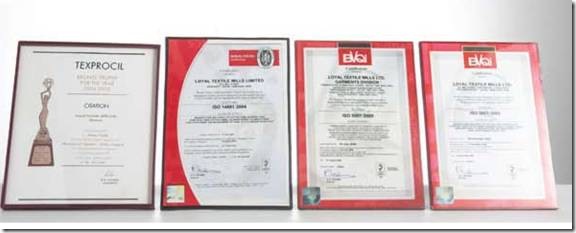
· ISO:9000:2000 Certified

· IS0:14001: EMS Certified

· SCAL Organic Productions MT Certified

· SA8000 Certification underway

· Corporate office under green building (IGBC) certification

Standard

· OAK Tech standards for dyed fabrics

· Bardush standards for European industrial wash

· BS 2576/1986 & ASTM D1424/1996 standards for fabric

· ASTM D5034/ASTM D1424 standards for dyed fabric

· ISO 13934-1/ISO 4074-2 dyed fabric for purpose

Awards

· Bronze trophy for the year 1997-98 for being third largest exporter of cotton

fabrics in the country

· Silver trophy for the year 1998-99 for being the second largest exporter of

cotton fabrics in the country

· Silver trophy by AEPC for being fourth largest exporter of garments under

non-quota category for the year 1999

· Bronze trophy for outstanding export performance in yarn amongst mill

exporters from TEXPROCIL for the year 2001-02

· Bronze trophy for the year 2004-2005 for being third largest exporter of cotton

fabrics in the country

· Gold Trophy for the year 2006-07 for being the largest exporter of cotton

fabrics in the country.

Joint Venture / Overseas Office

Gruppo P&P Loyal s.p.a
Via Valdilocchi, 2-19126
La Spezia, Italy
E mail: info@peployal.it

Loyal Textiles (UK) Ltd.
48, Bessencourt, Holmes Chapel,
Cheshire CW4 7NB, England
E mail: david@loyaltextiles.co.uk

clip_image044

clip_image046

Exports

The major markets for our products are as follows:

Garments Europe, Switzerland, Middle East and USA

Finished Fabrics UK, Sri Lanka, Dubai, Europe and USA

Home Textiles USA, Europe and Japan

Grey Fabrics USA, Europe, Hong Kong, South Korea, Israel and UK

Yarn Europe, Japan, Hong Kong, Korea, Australia, Spain, Egypt,

Israel , Turkey, Thailand, Taiwan and Bangladesh

Environmental Management system

(ISO - 14001)

· Complying with applicable environmental legislations and regulations

· Conserving natural resources through responsible management of energy and water use

· Dyeing of fabrics using extremely water frugal technology and E- control dyeing

· Waste water C.O.D and B.O.D reduced to acceptable levels using a combination of bio tower and areation tank

· Reducing environmental impacts through reuse, recycle and minimization of waste

· Adopting cost effective measures in the prevention of pollution from our processes

· Motivating and preparing all employees to take personal accountability for protecting the environ

· Planning, implementing and reviewing environmental objectives & targets

· Regularly reviewing and improving our environmental management system

Persons to be contacted:

Mr Manikam Ramaswami
Chairman & Managing Director
Ioyal@loyaltextiles.com

Mr KL Palaniappan Senior Vice President klp@loyaltextiles.com


clip_image050

Read more...