Showing posts with label Knitting. Show all posts

Circular Warp Knitting Machine

DETERMINATION OF MAIN GEOMETRICAL PARAMETERS
OF CIRCULAR WARP KNITTING MACHINE

T.S. Stoilov Y.K. Kyosev
Technical University of Sofia, Dept. of Textile Engineering,
8, Kliment Ohridski Blv, 1797 – Sofia, Bulgaria,
E-mails: yordan_kyosev@gmx.net jkiossev@tu-sofia.bg tstoilov@tu-sofia.bg
Introduction
The design of the circular warp knitting machines is actual, because such machines produce circular tubes or cables, quite suitable for some medical or technical applications, like arteries, veins, ropes etc [1,2,3]. These machines are rarely produced and their design is generally open problem. Our investigation shows, that there is one principal construction for machines with very small diameter, with different modifications [4,5,6]. Here we investigate the main points of the machine design – determining the number of needles, position and rotation angle of the yarn guide mechanism. This work differs from [7], as here is used cylindrical needle bed instead of conical one, presented in [7].

Minimal Rotation Step of the Yarn Guide
For the circular weft knitting machines is not efficient to be used forced yarn overlapping – it leads to some complications in the construction and the price. Instead of this, is used the relative motion between needle and yarn. This motion is realized by rotation of the yarn guide eye relative to the axe of the needle's cylinder.
In order the yarn to be laid in the needle hook, the yarn guide should make at least one minimal rotation step. This rotation step depends on the needle geometry and yarn diameter. The yarn with conditional diameter d should go trough the needle hook touching the needle stem and the point of the needle's hook, that are with diameter 2R.
clip_image002
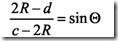
The relation between these parameters and the needle parameter c is given by the
overlapping angle Θ , see Fig.1 :
clip_image004
clip_image006
Yarn Guide Position
The yarn covers the needle as a result of the relative motion between them. The position of the yarn guide (height) is important for this process. On the Fig.3. is presented an axonometric projection of the yarn AE, where the point E is the yarn guide eye, and A is the point where lies the last needle. The yarn guide height is denoted as H, and the height,
where the yarn touches the needle is h = DB .
clip_image008

clip_image010
Needle Density
The needle density is determined on the condition that the yarn has to overlap only one needle by one step of the yarn guide. The cylinder of the needles with radius r and the width of the hook c (Fig. 1) is presented on the Fig.4. The yarn has built a loop at the needle Nr. 1 on the Fig.4, and is going through needle Nr. 2, till point 3, that is behind the needle Nr. 3. Here the thickness of the yarn and the needle are neglected.
clip_image012
The second and the third solutions have different signs, which doesn't influence their physical meaning. From the minimal central angle between the neighbouring needles could be determined the maximal number of needles for cylinder with diameter 2r and
the needle width is c, following

clip_image014
Consideration of the needle and yarn diameters in this equation will result in some corrections in equations (7)-(18). These corrections will change the results with the same size as the error derived by yarn overlapping (approx. 0.5mm) and therefore they are not included.
Conclusions

From the condition, that the yarn to overlap only one needle, is calculated the minimal central angle between needles and the maximal number of needles for given cylinder diameter. It is determined, that it is possible to be realised opposite overlapping, independent on the needle density. The height of the yarn guide and its rotation angle are also determined. All these equations are important when designing the circular warp knitted machines.
Read more...

Yarn Preparation For Weaving And Knitting

Yarn preparation involves those processes that improve the yarn's weaveability or knittability.
Preparation Requirements for Weaving Yarns Warp Yarns
Yarns must be aligned properly
Yarn strength must be increased
Yarn hairiness must be decreased
Yarn smoothness must be increased
Yarn elongation and flexibility must be sustained
Filling Yarns
Yarn must be wound properly and on a suitable package for high speed unwinding
Preparation Requirements for Knitting Yarns Weft Knitting
Yarn friction must be decreased Fiber shedding must be decreased Yarn smoothness must be increased
Warp Knitting
Yarn friction must be decreased
Fiber shedding must be decreased
Yarn smoothness must be increased
Yarns must be properly aligned for introduction to knitting needles
Yarn Preparation For Weaving And Knitting
clip_image002

Winding
Materials Processed
Input - Yarn (spinning bobbins)
Output - Yarn (large cones, tubes, etc.)
Objectives of the Process
· Inspect the yarn
· Clearing of defects
· Lubricate the yarn
· Package the yarn
clip_image004
Elements of Winding
· Yarn withdrawal
· Yarn tensioning
· Yarn clearing
· Stop motion
· Take up
Figure 8-1 Open Wind Coner
clip_image006
Yarn Preparation for Weaving
L Warping
A. An operation where yarn is transferred from single packages of yarn to an even sheet of yarn representing hundreds of ends and then wound onto a warp beam.
H. Producing An Even And Uniform Sheet Of Warp Yarn
A. The packages in the warper creel must be uniform in density, size, and wind configuration.
B. Tension applied in warping must be uniform throughout.
C. Contact surfaces which the yarn passes must be smooth and must not impede the progress of the yarn.
D. The speed of the warper must not exceed that at which the yarn can be withdrawn from supply packages without undue strain.
E. Warp winding speed must be controlled and maintained at a constant rate throughout.
III. Direct Versus Indirect Warping
A. Direct Warping
1. Warp is wound directly onto section beams.
2. Used predominantly in preparing yarn for warp knitting and weaving.
B. Indirect Warping
1. Warp is wound in bands onto pattern drum and then transferred onto a beam in a separate operation.
2. Used for fancy pattern warps or where creel capacity is limited.
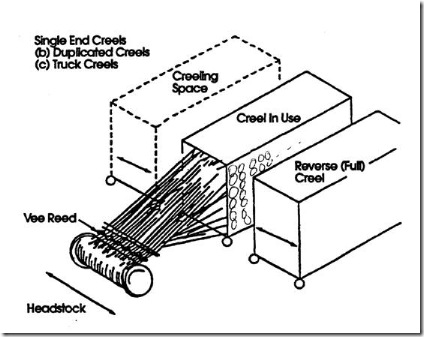
Figure 8-2 Single End Creels
clip_image008
Figure 8-3 Traveling Package Creel
clip_image010
Figure 8-4 Indirect Warping: Drum Warper


clip_image012
Slashing
L Objectives
A. Strengthen the yarn
B. Make outer surface of yarn smoother
C. Lubricate the yarn
D. Have no effect on subsequent processes or resulting fabric IL Why Warp Yarns Need To Be Strengthened
A. To overcome tension levels in the warp
1. Constant average tension determined by:
a. rate of take-up of cloth and let-off of warp
b. contraction of warp due to crimp
c. stretch of warp due to tension
2. Cycling variations in tension
a. due to shedding
b. due to beat-up
c. higher level in dense fabric
d. highest tension in cycle is where a weak yarn will break
3. Random variations in tension
a. due to large, badly shaped knot
b. yarn and fiber entanglements c. knot tails entangling
B. To overcome weaknesses in the yarn created by:
1. Yarn damage caused by the machine
2. Weak places in the yarn supplied
3. Inadequate distribution of load over all warp ends
4. Inadequate knotting or joining
III. Sections Of The Slasher
A. Beam creel
B. Size box
C. Drying unit
D. Warp separation
E. Headstock
IV. Size Add-On
V. Factors Affecting Size Add-On
A. Yarn characteristics
B. Number of ends and tension of warp
C. Squeeze roll control and conditions
D. Residence time of yarn in size box E. Viscosity of mix
VI. Important Ingredients In A Size Mix
A. Adhesives
B. Lubricants
C. Additives
D. Water or solvent
VII.Parameters Controlled In The Size Box
A. Level of size solution
B. Temperature
C. Concentration of size liquor
D. Squeeze roller pressure E. Yarn speed
VIII.New Sizing Techniques
A. High pressure squeezing
B. Hot melt sizing
C. Foam sizing
IX. Slashing Calculations
Figure 8-5 Slashing - Preparatory To Weaving
clip_image014
Requirements For A Quality Warp Beam
Objective: To Make A 'More Perfect Warp Beam"
· Ends wound straight and parallel to one another from beginning of beam to the end with each end holding its relative position in the warp with no "Rolled", "Crossed", "Stuck", or "Lost Ends".
· Tension uniform on all ends.
· Density of the warp is uniform from beginning of beam until full beam.
· . Selvage ends flat with the rest of the warp.
· Size added is uniformly applied on all ends and improves warp weaveability.
Warp Preparation
Drawing-In
Provides each warp yarn with its drop wire, heddle, and reed dent. Tying-In
When mass producing the same fabric by simply typing each end of a new beam to its corresponding end of the old beam


clip_image016
Side View Of A Loom
This sketch shows why the yarn must be flexible and lubricated to withstand the weaving operation. The warp sizing material must impart flexibility, elasticity, lubricity and abrasion resistance to the yarn.
Read more...

Fundamentals of Knitting

Knitting
To form a fabric by the intermeshing of loops of yarn.
clip_image002

Weft Knitting

Loops are formed by needles knitting the yarn across the width of the fabric.
Each weft thread is fed at right angles to the direction of fabric formation.

Warp Knitting

Loops are formed by needles knitting a series of warp yarns fed parallel to the direction of fabric formation.
clip_image004

In warp knitting all needles knit simultaneously for all yarns, while in weft knitting the needles knit in sequence for each yarn.
Figure 9-1 Weft (Circular) Knitting And Warp Knitting
clip_image006
Consumer Acceptance
Comfortable
Pliable
High extensibility
Easy care properties
Inexpensive
Apparel, home fashion, industrial
Productivity And Lead Time
Faster than woven
Shorter lead time, quick response Small lots
Body sizes, Full fashion
Use Of Fibers And Yarns
All fibers All yarns Low tensions/stress allow loop formation or entrapment
Capital Investment
Low initial cost
No expensive yarn preparation
Small area of floor space required
Few auxiliary machines needed for operation
Figure 9-2 Weft Knitting
clip_image008

Basic Weft Knitting Terminology

Course
Wale
Course Count
Wale Count Knit Loop Face Loop Back Loop Stitch
Tuck Loop Float Loop Yield
Course Length Cut or Gauge Gaiting Timing
Dial Height Back Loop
Stitch
Tuck Loop Float Loop Yield
clip_image010
clip_image012
clip_image014
clip_image016
clip_image018
clip_image020
clip_image022
clip_image024
clip_image026
clip_image028
clip_image030


clip_image032

Basic Weft and Warp Knitting Terminology

A. Course - the row of loops or stitches running across the width of a fabric corresponding to filling of a woven fabric.
B. Wale - in knit fabrics, a column of loops running lengthwise the fabric.
C. Course Count.- the number of courses in a knit fabric per unit length measure. For example: courses per inch.
D. Wale Count - the number of wales in a knit fabric per unit length. For example: wales per inch.
E. Knit Loop.- a stitch in a fabric Where the yarn is formed into a loop shape by the knitting elements. Knitting meshes or interlocks these loops to form a fabric.
F. Face Loop - a knitted loop formed on. the. cylinder needles on a knitted machine.
G. Back Loop - a knitted loop formed on the dial needles on a knitted machine.
H. Stitch - in knitting, a stitch is the loop geometry of a particular pattern repeat. . It may be in the form of a knitted, a tuck or a float loop.
I. Tuck Loop.- a knitted stitch when a needle receives a new yarn without losing its old loop.
.J. Float Loop - a knitted stitch when a needle holds its old loop and does not receive a new yarn. It connects two loops on the same course but not in adjacent wales. Also called a miss-loop.
K. Yield - the amount of fabric delivered off a knitting machine in terms of its weight per unit length or area, or the number of linear units delivered per unit weight. For example, ounces per yard, or ounces per square yard or yards per pound. •
L. Course Length - the amount of yarn used in forming all the knit-loops in one course of a knitted fabric. Also called run-in.
M. Cut or Gauge - the number of needles per inch in the circumference of the cylinder or dial of a knitting machine.
N. Gaiting - the spacing of the needles in the dial and the cylinder in relation to each other on rib and interlock machines. In rib knitting, the needles of the cylinder are between the needles of the dial. In interlock gaiting, the needles of the cylinder are directly opposed to the needles in the dial (opposed to each other).
0. Timing - the order the needles in the dial and cylinder go through the knitting cycle in relationship to one another. The cylinder needles that correspond to dial needles may go through the knitting cycle before or after the dial needles.
P. Dial Height the distance between the bottom edge of the dial section on a knitting machine at its perimeter from The corresponding upper edge of the cylinder at its perimeter.
A. Tricot - a type of warp knitting in which spring bearded needles are normally used to make fine fabrics with usually one to three warps are used.
B. Raschel - a type of warp knitting in which plain and jacquard fabrics can be made.
Raschel fabrics are normally coarser than other types Of warp knits, :but a wide range of fabrics can be made. Raschel machines may have one or two sets of needles and up to thirty guide bars.
C. Gauge - the number of needles per linear inch of the needle bar. For most warp knits that refers to a one linear inch, but can be for two.
D.. Guide Bar - a mechanism on a warp knitting machine which directs warp yarns to the knitting needles, and their movement is controlled so that patterns can be knit.
E. Needle Bar - a flat metal plate with slots (tricks) cut into it at regular intervals into which needles slide during the knitting process.,
F. Runner Length - in warp knitting the number of inches of yarn needed to knit one rack of fabric.
G. Rack - a warp knitting measure of 480 courses. Tricot fabric quality is judged by the number of inches per rack.
H. Inch Quality - a measure of quality of warp knit fabric, the number of inches of fabric per rack.
I. Full Set - a term that indicates that all guide eyes in a guide bar each have a yarn from the warp.
j. Part Set - a term that indicates that all guide eyes in a guide bar do not have a yarn from the warp.
K. Positive Feed - when the yarn is metered off the warp beam by a metering device.
L. Negative feed - when the yarn is pulled off the warp beam by the knitting action of the needles during the loop forming step.
M. Pattern Wheel - a cylinder or wheel upon which a pattern chain is placed which has links of different heights so as to move the guide bars throughout its pattern.


clip_image034

clip_image036
Effects Of Tucks And Floats On Knitted Fabrics
Tuck Loop
· Makes the fabric wider
· Makes the fabric thicker
· Makes the fabric slightly less extensible
Float Loop
· Makes the fabric narrower
· Makes the fabric thinner
· Makes the fabric much less extensible
clip_image038
clip_image040
clip_image042
Weft Knitting Notation
Verbal
1 x 1 Rib - Fabric made with face loops and back loops alternating in same course but not same wale. Made on dial and cylinder machine with rib gaffing.
clip_image044
2 x 2 Rib
Machine Requirements
A rib machine.
Only one came race and one type of needle for the cylinder dial. Rib gaiting
Needle Setout
Needles not knitting must be removed from the machine Needle Selection
All at every feed
Fabric Properties
A one feed repeat.
Same appearance on both sides. Good crosswise extensibility.
clip_image046
clip_image048
clip_image050
clip_image052
Interlock
Machine Requirements
An interlock or eightlock machine.
Long and short needles in both the cylinder and dial. Interlock gaiting and usually delayed timing.
Needle Setout
Needles alternately arranged long and short in the cylinder and dial. Needle Selection
Dial Needles Cylinder Needles
Knit short Knit short
Knit long Knit long
Fabric Properties
A two feed repeat.
Same appearance on both sides. Tight and stable construction. Does not curl.
clip_image054
Ponte Di Roma
Machine Requirements
An eightlock machine.
Long and short needles in both the cylinder and dial. Interlock gaiting (Rib gaiting can also be used) and usually delayed timing.
Needle Setout
Needles alternately arranged long and short in the cylinder and dial. Needle Selection
Dial Needles Cylinder Needles,
Knit short Knit short
Knit long Knit long
Miss all Knit all
Knit all Miss all
Fabric Properties
A four feed repeat.
Same appearance on both sides. Tight and stable construction. Does not curl.
clip_image056
clip_image058
clip_image060
Properties Of Weft Knits
Stretch and recovery Wrinkle Recovery Thickness
Air Permeability
Shrinkage
Snagging
Pilling
Curling
clip_image062
Figure 9-26 Diagram Of A Typical Tricot Machine: The
Front Is At Right
clip_image064
Warp Knitting
L Basic Warp Terminology
A. Tricot
B. Rachel
C. Guage
D. Guide Bar
E. Needle Bar
F. Runner Length
G. Rack
H. Inch Quality
I. Full Set
J. Part Set
K. Positive Feed
L. Negative Feed M. Pattern Wheel
IL Basic Warp Knit Actions
A. Spring Beard Needle
B. Latch Needle
C. Compound Needle
III. Design Variables
A. Yarn Characteristics
B. Threading
C. Underlap Length and Position
D. Number of Bars
E. Fabric Enhancement
IV. Fabric Classifications
A. One Bar
B. Two Bar
C. Three Bar
D. Multiple Bar
V. Warp Knitted Fabric Notation
A. Verbal
B. Graphic
C. Numerical
D. Diagrammatic
clip_image066
clip_image068
Comparison Of Latch Needle and
Spring Beard Needle
Latch Needle Spring Beard Needle,
Latched Not latched
Self-closing To be closed
Forms loop Requires help to form loop
Expensive Cheaper
Coarser Finer
Low needles per inch More needles per inch
clip_image070
clip_image072
clip_image074
clip_image076
clip_image078
clip_image080
clip_image082
Standard Two Bar Fabrics
Tricot Jersey (Full Tricot)
Front Bar 1-2/1-0/
Back Bar 1-0/1-2/
Locknit
Front Bar 2-3/1-0/
Back Bar 1-0/1-2/
Reverse Locknit
Front Bar 1-2/1-0/
Back Bar 1-0/2-3/
Loop Raised
Front Bar 1-0/3-4/
Back Bar 1-0/2-3/
Sharkskin
Front Bar 1-0/1-2/
Back Bar 3-4/1-0/
Satin
Front Bar 3-4/1-0/
Back Bar 1-0/1-2/
OR
Front Bar 4-5/1-0/
Back Bar 1-0/1-2/
Queenscord
Front Bar 1-0/0-1/
Back Bar 3-4/1-0/
OR
Front Bar 1-0/0-1/
Back Bar 4-5/1-0/
clip_image084
clip_image086
Diagram of a Simple Raschel Crochet Knit
clip_image088
Figure 9-33 Diagram Of A Knitted Net
clip_image090
Figure 9-34 Diagram Showing Laying In Yarn to Form
Designs: Some guide bars are left empty.
clip_image092
Characteristics Of Warp Knit Fabrics
Extremely versatile in pattern effects with yarn Rigid to elastic
Cannot be raveled
Good air and water permeability
Good crease resistance
Good drapability
Good dimensional stability
Good Strength
Read more...